Trida Signals
Blog
AI engineering insights from the field — LLMs, agents, and production lessons.
Get updates
Blueprints
Manufacturing Plant Operations Agent Blueprint
Blueprint: a plant operations agent that works the shift's exception board in a priority order fixed by rule, thinks each case through in checked rounds against the plant's procedures and parts shelf, and stops at the supervisor's gate.
Field Notes
Agent Tracing in Production
When an agent gives a wrong answer, the final text is the one part of the run you don't need to debug. A trace — one run broken into timed steps for every model call, tool call and retrieval — turns "it failed" into the exact step where it failed, and what that step was looking at when it did.

Field Notes
Idempotency for Agent Actions
A timeout after a write tells you nothing about whether the write happened. Agents retry anyway, through frameworks, queues and restarts as well as their own loops, so every action with a side effect needs a stable key, a record of what it did, and a reconciliation path for the systems that offer neither.
Field Notes
Model Upgrades Are Deployment Events
Swapping the model is a one-line edit. Proving the replacement still does your job — on your prompts, your data, your awkward edge cases — is a release: an inventory, an eval replay by slice, a shadow run, a canary, and a rollback that only works while the old model still exists.
Academy
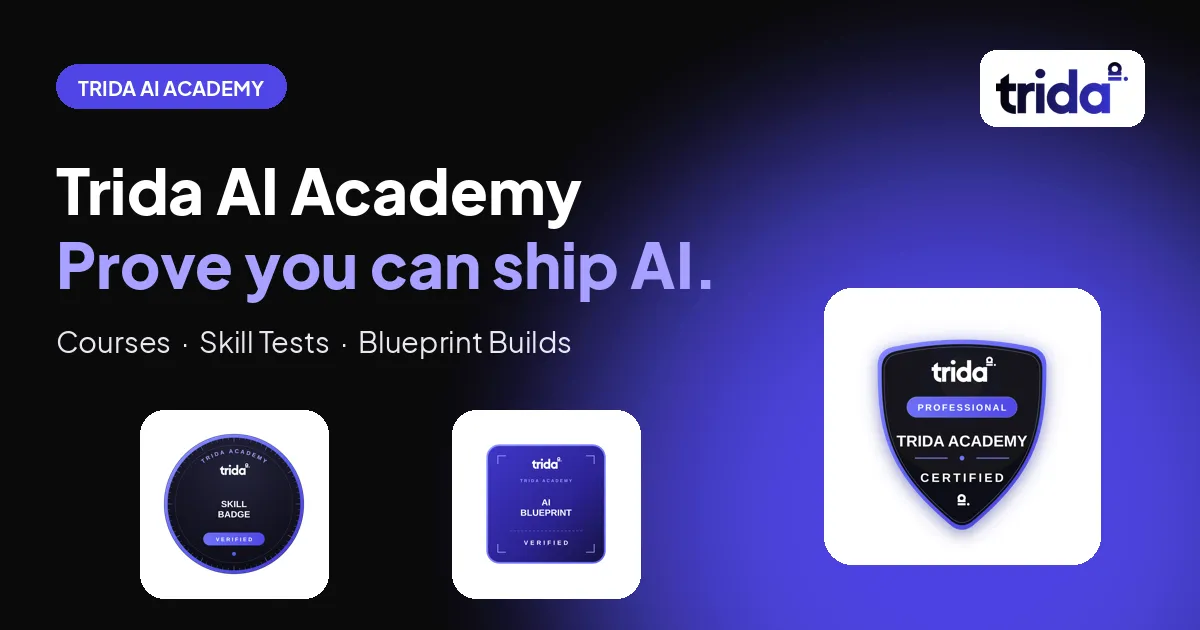
The Trida AI Academy: Courses, Skill Tests, and Blueprint Builds
Trida AI Academy is the proof system behind forward deployed engineering: certifications earned by passing, skill badges earned under time pressure, and blueprint builds reviewed by a person — all of it landing on one verified profile that Trida Network puts in front of recruiters.
Field Notes
Sandboxing Agents That Run Code
An agent with a shell inherits everything the shell can reach — your files, your keys, your network. A sandbox replaces per-command permission prompts with an enforced boundary: a short list of files, hosts and credentials the code can touch, and nothing else.

Field Notes
Too Many Tools Hurt Agents
Giving an agent every tool you own makes it worse at choosing one. The measured fix is a shortlist: keep a small core resident, retrieve the rest per request, and spend the saved context on the work itself.
Field Notes
Structured Output Is Not a Guarantee
Schema-constrained generation guarantees the shape of a model's answer — every required field present, every type right, every enum legal. It says nothing about whether the values are true. Production systems still need semantic validation, bounded repair, and a reject path.
Field Notes
Multi-Agent Systems in Production
Multi-agent systems earn their cost in one shape of work — breadth-first, read-heavy, loosely coupled — and lose it in another. The evidence from the teams and researchers who have measured them points to the same dividing line: fan out for reading, keep writing and deciding in one thread.