
Manufacturing Plant Operations Agent Blueprint
A shift starts with a board, and the board is an argument. Overnight, a press went down and stayed down. A quality hold sits on a batch nobody wants to release. A maintenance alert is blinking, and someone logged a safety observation near a guard that doesn't sit right. Four problems, one crew, and a supervisor deciding what gets attention first.
This open blueprint, the Plant Operations Loop Agent, works that board: cases in a priority order fixed by rule, each thought through in rounds, every plan checked against the plant's procedures and its parts shelf. Then it stops. Every case ends in front of the supervisor as a draft work order or an escalation note. The agent never issues a command to a machine, never marks work as performed, and never closes a case.
The order is decided before any thinking starts
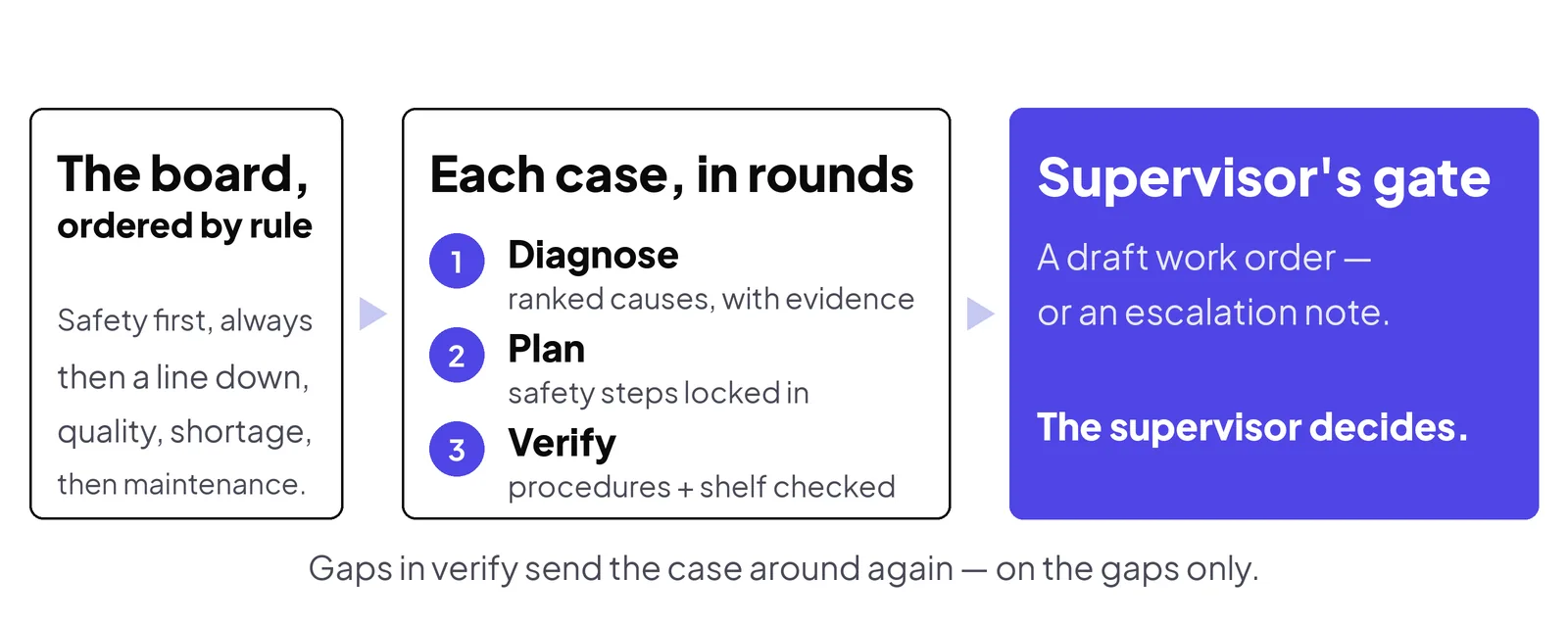
The first discipline is that the model never chooses what to work on. Priority is computed by rule: a safety observation goes first, always. Then a line that's down, then quality, then a material shortage, then maintenance — weighted by how critical the line is and, for a machine that's down, by how long it has already been down. If the shift's budget runs out mid-board, the run stops between cases, never inside one, and the remainder goes to the next shift in writing, with reasons. Nothing quietly falls off the board.
Money sits beside this order, deliberately outside it. Each case carries an estimated cost of downtime, but the figure never reorders the work: a maintenance alert with a large dollar estimate still waits behind a smaller line-down case, because triage is a safety judgment before a financial one. The supervisor sees both numbers; the dollar overlay stays her call. And a safety case is never priced at all. Not zero. Absent.
Each case gets thought through, not answered
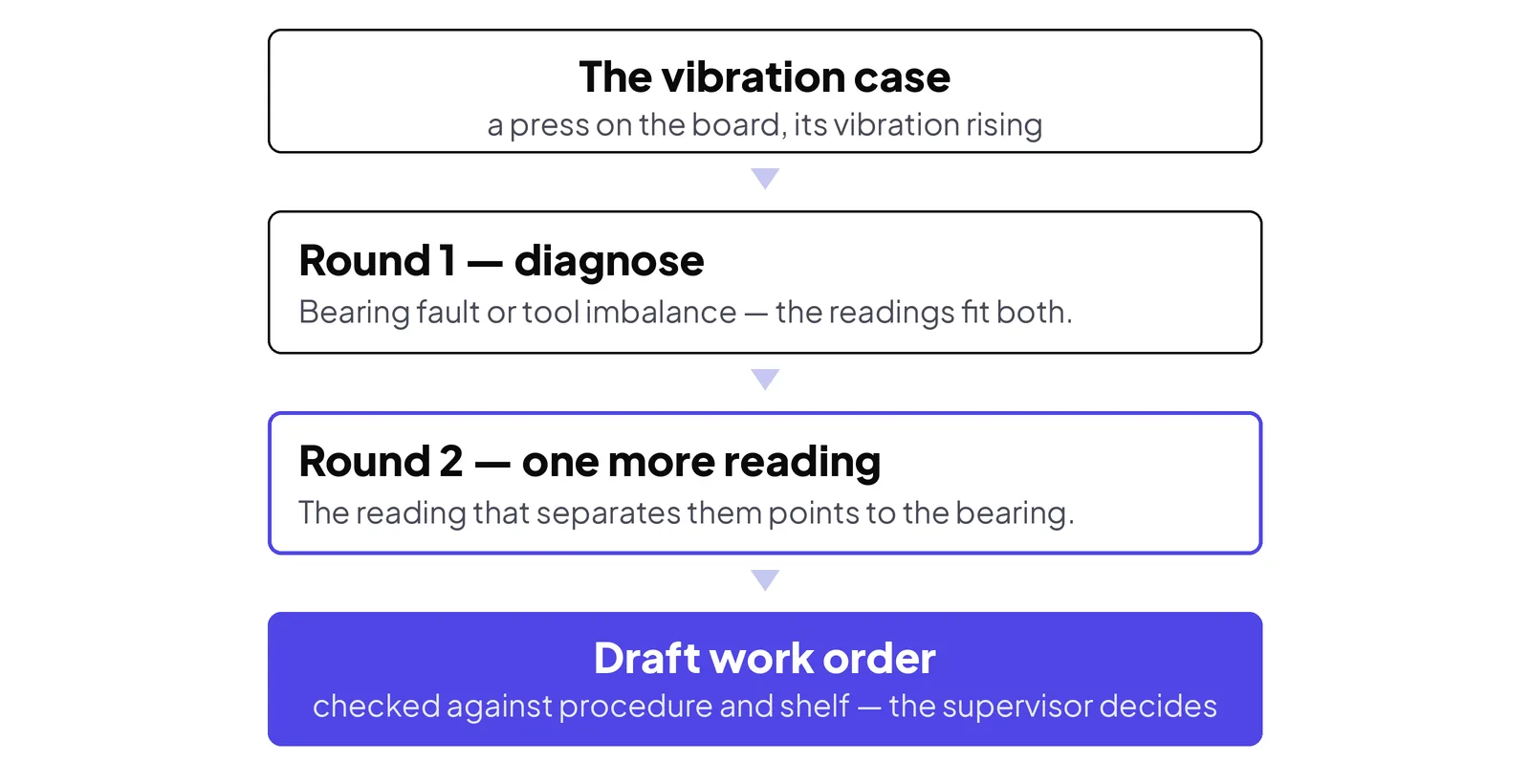
Inside a case, the agent works in rounds of three. First it diagnoses: a ranked list of what could be wrong, each explanation carrying its evidence — a procedure clause for that machine, a match in its history, a reading from the floor. One with no evidence is recorded as a gap. Then it plans on the leading explanation's procedure, whose mandatory safety steps (isolation, lockout, the checks before anyone opens a guard) enter as steps nothing downstream can remove. Then it verifies: the model takes a second, critical look, and rule-based checks run alongside it — a missing safety step, a missing part, thin evidence, a step contradicting the procedure, a step that should never be proposed at all.
If verify finds gaps, the case goes around again, on the gaps only. It leaves the loop verified clean, as a draft work order; out of rounds, escalated with the gaps named; or stopped early, when the part it needs exists only in the outside world or a safety rule ends the discussion.
Safety gets a shorter path. A safety observation is never diagnosed at all; it escalates at the very start, before any model is consulted. A plan step proposing to defeat a safety device stops its case that round. And the floor's own words are screened first: operator notes count as information, not instruction. A note suggesting the lockout be skipped to save time is flagged on the record, struck from what the model sees, and the plan is screened again for exactly that move.
The shelf gets a vote
Plans fail in plants for an unglamorous reason: the part isn't there. So before a plan can verify, every part it needs is re-measured against the shelf as it stands. When the shelf can't satisfy a requirement, the agent searches its recorded compatibility knowledge for a substitute. A candidate must be in stock and clear the procedure's constraints for that slot: a fan rated below the airflow the procedure requires is not a substitute, whatever the catalogue calls it. One that passes is written into the plan as a first-class fact and flagged on the draft work order, so the supervisor approves it knowingly or not at all. If nothing passes, the case escalates with the search documented.
The shelf is shared, and the board plans like it. When two cases want the last unit of the same part, the higher-priority case holds it and the other blocks, the reason stated plainly on its record. If the supervisor rejects the winning case, the claim releases and a fresh run can plan the other case around the freed part.
The supervisor decides, and the plant remembers
The gate is the design's centre of gravity. A draft work order is exactly that: a draft, carrying the diagnosis and its evidence, the steps in order, the safety steps as a check-off list, parts with substitutions flagged, blank sign-off lines. The supervisor approves it, rejects it, or amends it — and her amendments, a part swap or a struck step, are recorded as hers and re-verified by the same checks before approval can stand. A mandatory safety step cannot be struck at all. The agent's side of the line is thinking and paperwork. Hers is the plant.
After the work, the supervisor records what actually happened; the loop closes in the direction most demos skip. The plan followed, changed or refused; the fault the floor actually found; the real downtime; the parts used. A confirmed fault is written back into that machine's history, where the next diagnosis reads it as the floor's own finding. It changes behaviour: the vibration case that once burned all its rounds can settle in two, once a supervisor has confirmed that machine's actual fault. And when the same machine faults the same way three times inside a fortnight, a watch raises it as a reliability problem rather than a fourth repair; the system drafts a preventive-maintenance proposal with its interval arithmetic printed on it, to approve, adjust or reject.
Honest limits
The reasoning is led by Muse Spark behind a replaceable connection, and that connection's status belongs in the open: the live model path is built and checked against the provider's documented behaviour, but it has not yet been run live end to end, and the blueprint doesn't claim otherwise. What runs today is a rules-based stand-in working from the procedures' thresholds — enough to prove the loops and the checks, openly no substitute for a model's judgment. Swapping the model is a gated act, too: a candidate must work a fixed set of cases and stand comparison against the standing record, safety cases as pass-or-fail pins, before it is trusted with a board.
The plant data bundled with the blueprint is a stand-in set. A deployment points the same loops at the plant's own maintenance systems and document store, replacing procedures and thresholds with the plant's own first. The checks prove the agent behaves as designed, including on planted bad behaviour: a planner that drops a safety step, one that reaches for a part that isn't stocked, one that proposes bypassing an interlock. That is a regression gate, not a promise about your floor. And the last limit is the boundary itself: an agent that never touches a machine can't rescue a plant whose bottleneck is the decision. If drafts wait hours for a supervisor, the handoff shows that plainly. What the waiting buys is thinking already done, evidenced and checked.
Work with us
If your supervisors start each shift triaging a board of exceptions from memory, while the procedures, the machine histories and the state of the shelf live in four different places, that's the deployment this blueprint sketches. Tell us about your plant through Trida AI's intake, and talk with the founders and engineers who would build it with you.
Get the Code on GitHub: github.com/tridaai/blueprint-manufacturing-plant-operations