The Trida AI Academy: Courses, Skill Tests, and Blueprint Builds
Every company hiring forward deployed engineers runs into the same problem: the role is proven in production, but it is hired on paper. A resume lists technologies. A profile lists keywords. Nothing in the standard process shows whether an engineer can take a problem, build the system, and ship it. So hiring becomes a bet, and when the bet is wrong, it surfaces inside a customer's deployment.
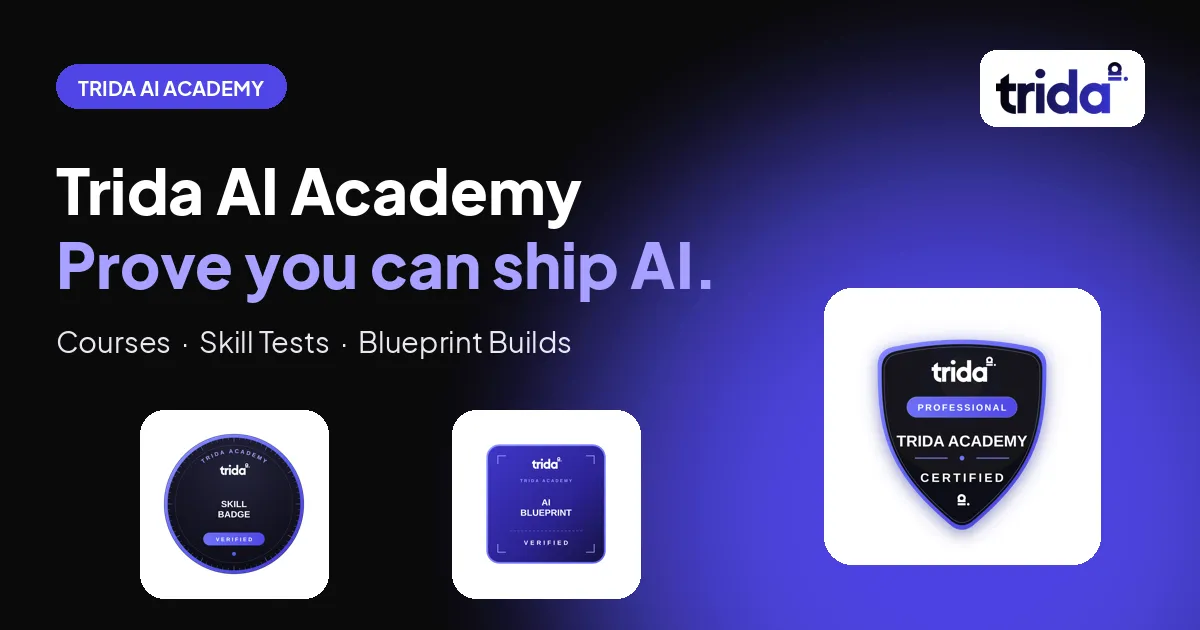
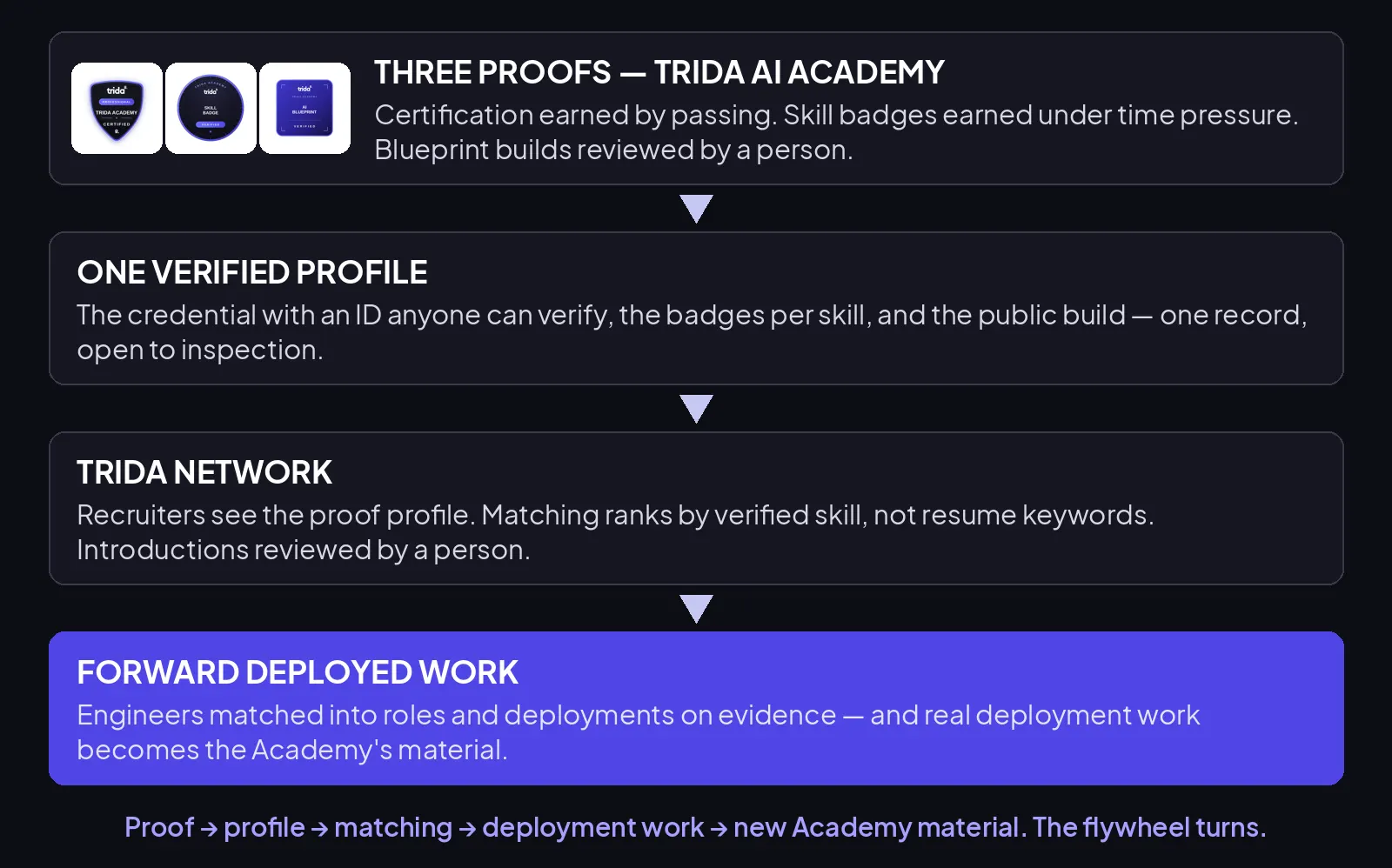
Trida AI Academy is the proof system we built instead. At its core are three kinds of evidence: certification courses an engineer passes to earn a credential, skill tests that badge individual skills under time pressure, and blueprint builds — complete agents, built to a specification and reviewed by a person. Each one leaves evidence. All of it lands on a single profile. And that profile is what carries an engineer into Trida Network, where recruiters and companies see verified skill instead of claims. That is the flywheel: prove you can ship, be seen for it, get matched on it.
Proof one: certification
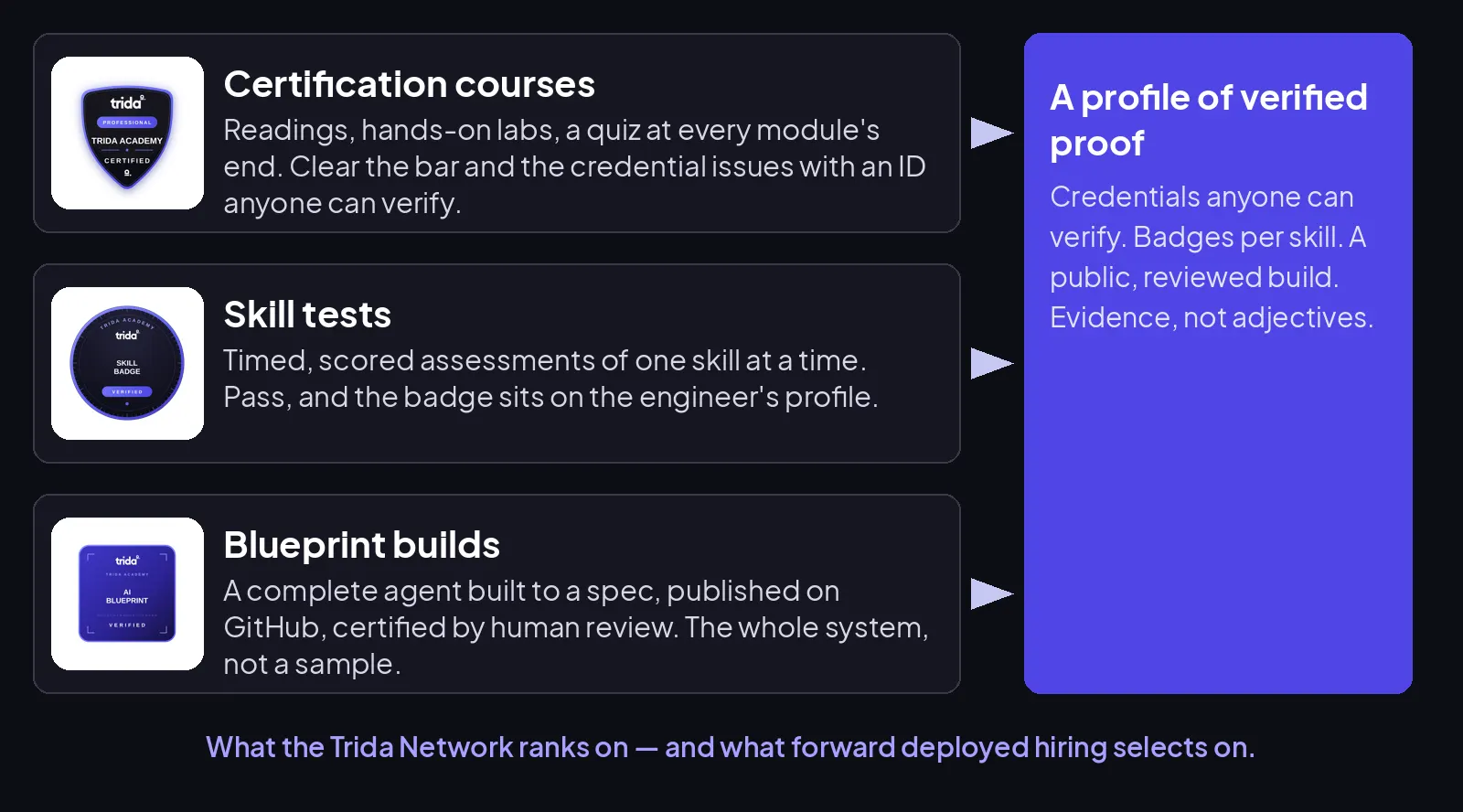
A certification course is the foundation. Engineers work through readings and hands-on labs, material built from real deployment work: production repositories, evaluation sets, the failure modes that only appear after launch. Every module ends with a quiz. There is no proctor and no cohort schedule; if a module does not clear, the engineer goes back, learns the part that was missed, and takes it again. Clear the core modules and an elective, and the credential issues automatically, carrying a unique ID that anyone can verify.
The credential is not attendance. It is a recorded pass, and the ID means a recruiter, a customer, or we ourselves can verify it.
Proof two: skill badges
Certifications establish breadth. Skill tests pin down the individual skills a deployment turns on. Each test is timed and scored, one skill at a time. Pass, and the badge goes on the engineer's profile.
The granularity matters. An engineer can be strong on retrieval and new to orchestration. A shelf of badges says precisely where the strength is, skill by skill, each one earned under time pressure rather than typed into a profile. For anyone evaluating an engineer, it reads like a map instead of a claim.
Proof three: blueprint builds
The third proof is a finished system. In Blueprint Builder, the engineer takes a specification for a real working agent in a real business vertical, written the way production systems are actually run, with a human holding the decisions that carry consequences. They build the agent end to end, publish it on GitHub, and submit it for review. A person reviews and certifies the build; it is not auto-graded, because what makes a build good is judgment, and judgment does not reduce to a test suite.
That matters for forward deployed work, because the job is never a slice of a system. It is the whole system, shipped.
The profile is the point
None of the three proofs lives in a drawer. The credential, the badges, and the reviewed build collect on one Academy profile: a record a third party can open and inspect. Verify the credential ID. Read the build on GitHub. See which skills carry badges. An engineer moving toward forward deployed roles does not have to argue that they can ship. The profile shows the evidence, in the open, before the first conversation.
Then the Network takes it from there
A verified profile is only useful if the right people see it. Trida Network matches Academy-certified engineers with companies, ranked by verified skill, not resume keywords, and introductions are reviewed by a person before they happen. Recruiters browsing the Network are looking at proof profiles: the credential, the badges, the public build. Companies can shortlist on evidence that was produced in the open, and engineers get seen for what they demonstrably can do.
Why we built it this way
Trida AI is a deployment company, and the quality of a deployment is the quality of the engineers on it. "Trust us" is not a quality system. The Academy makes the standard inspectable: the courses, the tests, and the blueprints are public, and anyone can look at what they ask of an engineer. For companies, that means an engineer's skills can be evidenced before they ever touch a production system. For the market, it means the supply side of forward deployed talent gets built on proof instead of paper — and the loop is designed to compound: engineers prove themselves in the Academy, the Network matches them on that proof, and the Academy's material is built from real deployment work, so every round of the system is grounded in the work itself.
What proof does not settle
Proof covers skill. It does not measure fit, taste, or how an engineer works inside a particular team, and no credential settles those questions. That is why the blueprint review is a human judgment and why Network introductions are reviewed by a person. Evidence removes the cheapest doubt in hiring — whether the skill is there at all. The rest still takes people.
See the proof system
Start with the courses, where the foundation is earned and certified.
Test a single skill against the clock with a skill test, and put the badge on a profile.
Or go straight to the build itself: build a blueprint, in the open, reviewed by a person.