
Why AI Pilots Stall Before Production
Every AI pilot begins in a friendly room. The data is a clean export, the questions are prepared, and the model performs. Six months later the same system is still "in pilot," and nobody can quite say why.
The gap between those two moments is not a model gap. It is everything the demo was allowed to skip: live data, real permissions, undocumented steps, security review, and an owner. Production is where those bills come due.
The stall shows up in the numbers. In S&P Global Market Intelligence's 2025 survey of more than 1,000 respondents, the share abandoning most of their AI initiatives jumped to 42%, up from 17% the year before, and the average organization scrapped 46% of its proofs of concept before they reached production. Gartner expects over 40% of agentic AI projects to be canceled by the end of 2027, naming escalating costs, unclear business value and inadequate risk controls. And when RAND interviewed 65 experienced data scientists and engineers, the most common root cause was not the technology. It was stakeholders misunderstanding, or miscommunicating, the problem the AI was meant to solve. RAND's report notes estimates that more than 80% of AI projects fail — twice the rate of IT projects that do not involve AI.
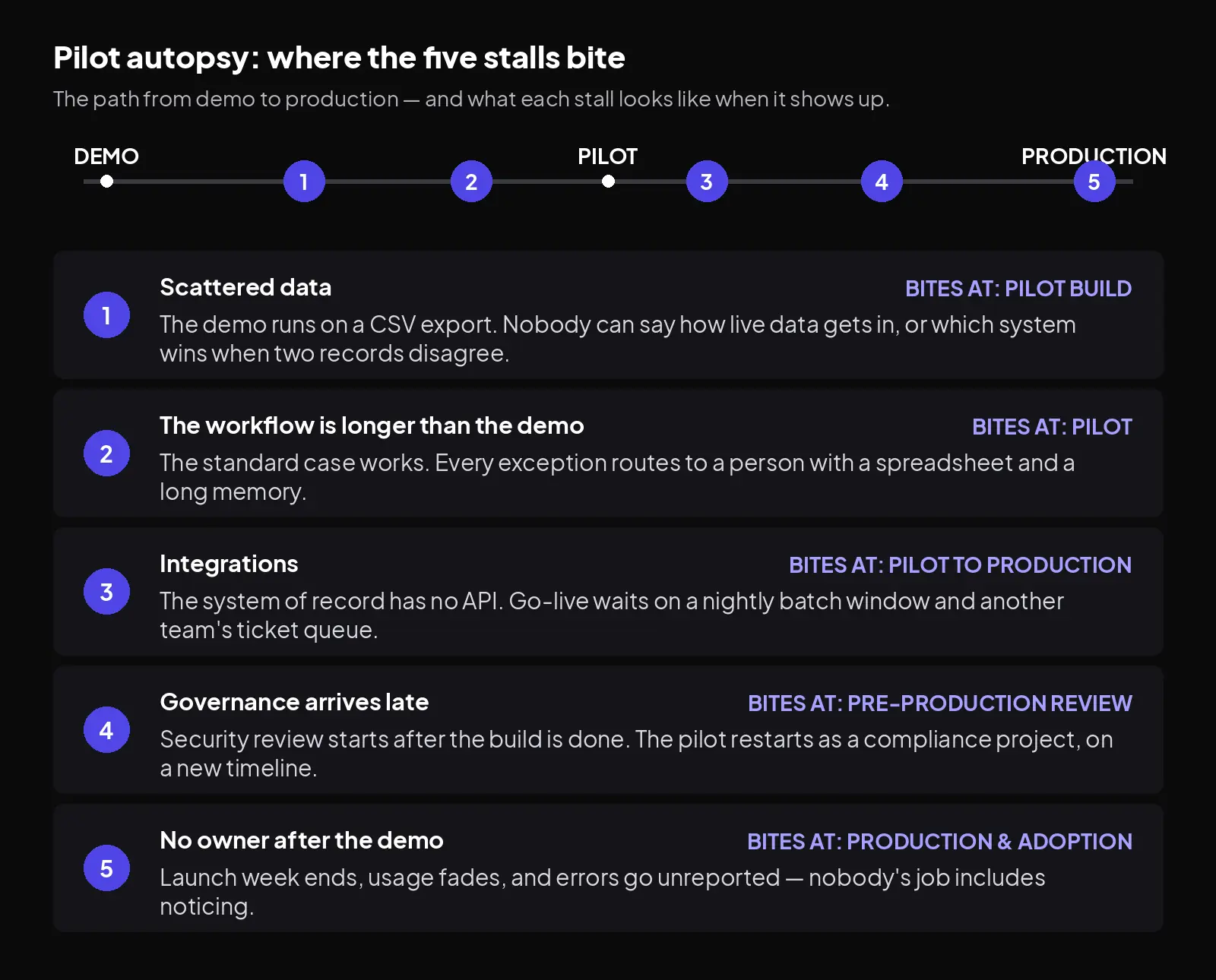
Three methods, one shape: pilots rarely die because the model wasn't good enough. They die between a working demo and a working business process. That space has five regular hazards.
The data is never in one place
A demo runs on an export. Production runs on the record in the legacy system, the update in the newer one, and the spreadsheet that one team quietly treats as the truth. None of these agree with each other, and the pilot inherits every disagreement.
This is why data work dominates real deployments. Before a model can answer questions about orders, claims or invoices, someone has to decide which system wins when they conflict, how records move, and who may see what. Skip that work and the pilot answers from stale data with full confidence, which is worse than not answering at all.
The workflow is longer than the demo
Demos cover the standard case. Real workflows are mostly exceptions: the invoice that doesn't match the purchase order, the claim that needs a second approval, the request that only makes sense if you know what happened last quarter. The steps are rarely written down. They live in the habits of the people who do the work.
RAND's interviewees put problem definition first for a reason. A team that builds against the workflow it imagined, rather than the one that exists, ships a system that handles the routine cases and creates a new manual queue for the rest. The pilot looks successful in review meetings and quietly fails at the desk where the work happens.
Security and governance arrive late
Access control, data residency, audit trails, retention: in most organizations these are reviewed at the end, by people who were not in the room at the start. When the review happens, it finds design decisions it cannot approve, and the pilot restarts as a compliance project.
S&P's respondents put cost, data privacy and security risks at the top of their obstacle list. The fix is sequencing, not argument. Governance requirements are design inputs. A deployment that starts with them builds differently: narrower data access, logged actions, human approval where the risk sits. Review becomes a formality instead of a verdict.
Integration is the long tail
Every pilot deck has a diagram with clean arrows between systems. The arrows are the project. Underneath them sit the realities: the system of record with no API, the identity provider that needs a separate approval, the vendor whose export runs once a night.
Integration estimates fail because they price the happy path: two modern systems, documented interfaces, a test environment that works. The path runs through procurement, change windows and other teams' priorities. Teams that map the integrations before building can sequence around them. Teams that discover them during the build spend the pilot's credibility waiting on tickets.
Nobody owns it after the demo
Pilots belong to innovation teams, vendors, or a sponsor who has since moved on. Production needs something less glamorous: a named person in the business whose own results depend on the system working, who answers for its accuracy, and who notices when people stop using it.
Without that owner, a pilot is never formally killed. It fades. Usage drops after launch week, errors go unreported because nobody's job includes reporting them, and the system joins the shelf of tools the company pays for and routes around. Gartner's "unclear business value" is often this, seen from a distance: value that nobody was assigned to prove.
How we work through it
Forward deployed engineering is our answer to a specific observation: the five hazards above live in the client's environment, so the engineering has to happen there too. Our deployments run as five stages, each with a gate that has to be passed before the next begins.
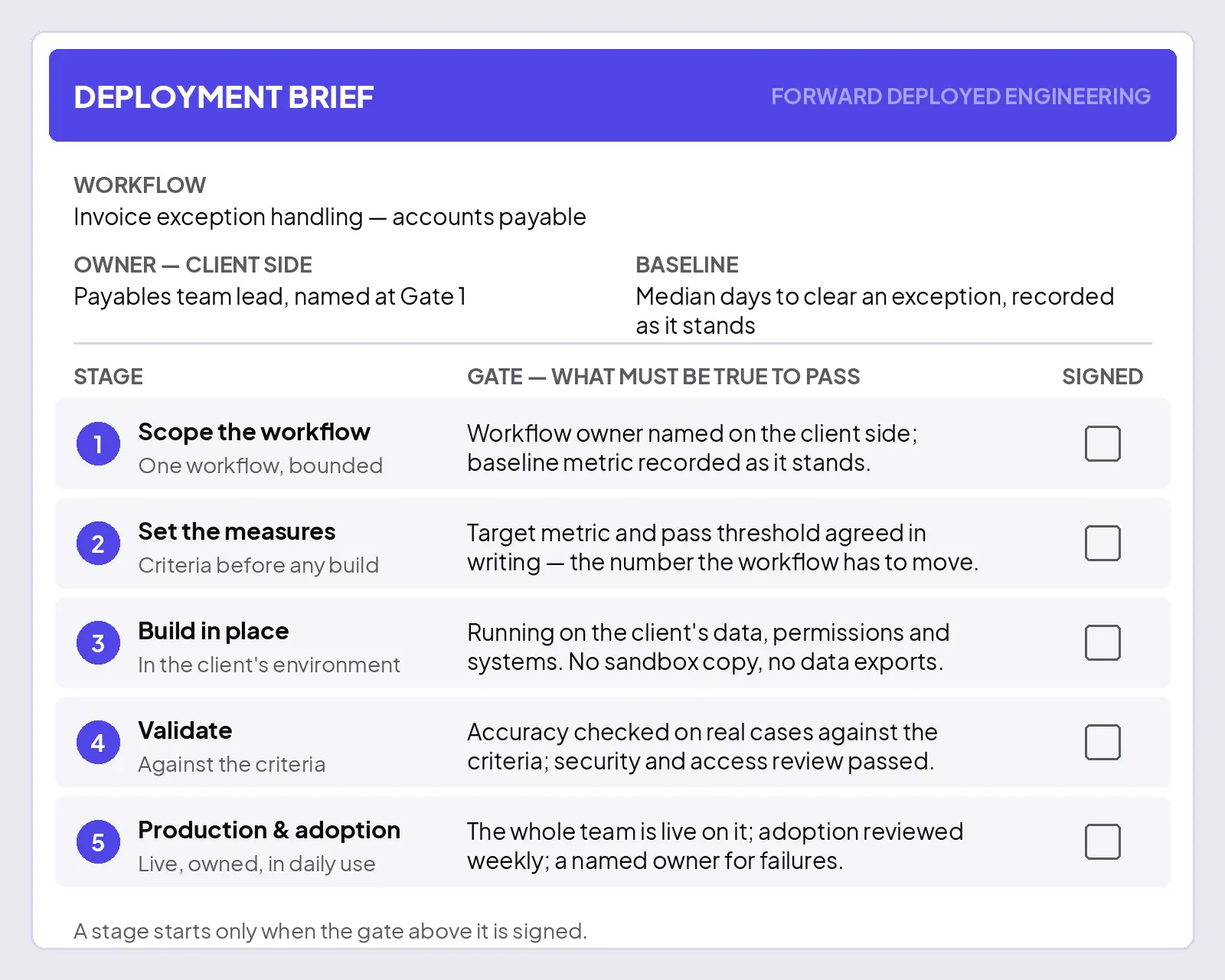
The order is the point. Success criteria come before building, because a pilot that can't say what number it moves will be judged on impressions. Building happens in the client's environment, on their stack and their permissions, because a system proven in a sandbox has proven the wrong thing. Validation covers accuracy, security and reliability together, because a fast, wrong, unaudited answer is not a result. And the final stage is not a handover document. It is production use, with adoption support, until the workflow's owner runs it as part of the job.
Where this doesn't help
Some pilots should stall. RAND's list includes problems too hard for current AI, and no deployment method fixes those. Others stall because the organization isn't ready: no owner willing to be named, no access to the data the workflow needs. In those cases the honest deliverable is a short answer — not yet, and here is what would have to change — rather than a longer pilot.
Each new workflow brings its own data, its own exceptions and its own owner. What carries over is the discipline: one problem, measured, in production — then the next.
Work with us
If you have a pilot that demos well and ships never, the problem is rarely the model, and a week of looking at the data, the workflow and the ownership usually finds it. Bring us the workflow through Trida AI's intake and we will tell you plainly where it is stuck and what it would take to get it into production.