
Who Do Your Deployment Engineers Work For?
Anthropic sells models. This month it committed $100 million to something else: training engineers it doesn't employ, because — in its own words — the people who can make AI work inside a real business "have become the hardest talent to find." When a model lab spends nine figures on deployment talent, the argument about what the bottleneck in enterprise AI actually is, is over. It isn't the model.
The interesting question is the one the announcement doesn't ask. Ten thousand new deployment engineers are coming. Who will they work for?
What Anthropic announced
The Claude Frontier Academy, announced October 2, aims to train 10,000 Frontier Deployed Engineers by the end of 2027. It is built like a medical residency, and the design is genuinely good: a multi-day intensive with Anthropic's own engineers, a simulated enterprise deployment that runs from use-case selection through security review to handover, a graded practical that earns a Resident Engineer badge, then a 12-week residency in which the engineer leads a real Claude deployment at their own employer, before a final assessment earns the full Frontier Deployed Engineer badge. The first cohorts, drawn from Accenture, Bain, Capgemini, Deloitte, McKinsey, Morgan Stanley, Commonwealth Bank of Australia and Novo Nordisk, are already running in San Francisco, New York and London. The first Frontier Deployed Engineer badges are expected in early 2027.
None of that is criticism. It is a serious program, run by the people who know the model best, and the engineers who finish it will be good. If your company is standardizing on Claude and already works with one of those firms, nominate your strongest people and don't think twice.
The catch is structural, not quality
Look at who the program serves. Entry is by nomination, through companies in Anthropic's partner network — the global consultancies and banks in the first cohort are the shape of the whole thing. The training is deep and narrow by design: one vendor's models, one vendor's deployment standard, inside firms whose partner economics run through that vendor. A graduate scoping your AI program knows Claude the way few people on earth will. They are also, structurally, a Claude engineer. When they recommend the architecture, the model choice has been made before the first workshop — not out of bad faith, but because it's the tool they were built to wield.
Three gaps follow. Companies below the global-consultancy tier aren't in the room: no nomination, no cohort, no badges. Companies running mixed estates — Claude for one workload, another lab's model for a second, open-weight models inside the VPC for a third — need engineers who can run the whole board, and a single-vendor bench can't. And the calendar: the demand for deployment engineers is this quarter, while the academy's first credentialed graduates arrive in early 2027 and the 10,000 figure is an end-of-2027 target. A well-built pipeline is still a pipeline. It doesn't staff the project you approved in October.
The other way to build a bench: open proof
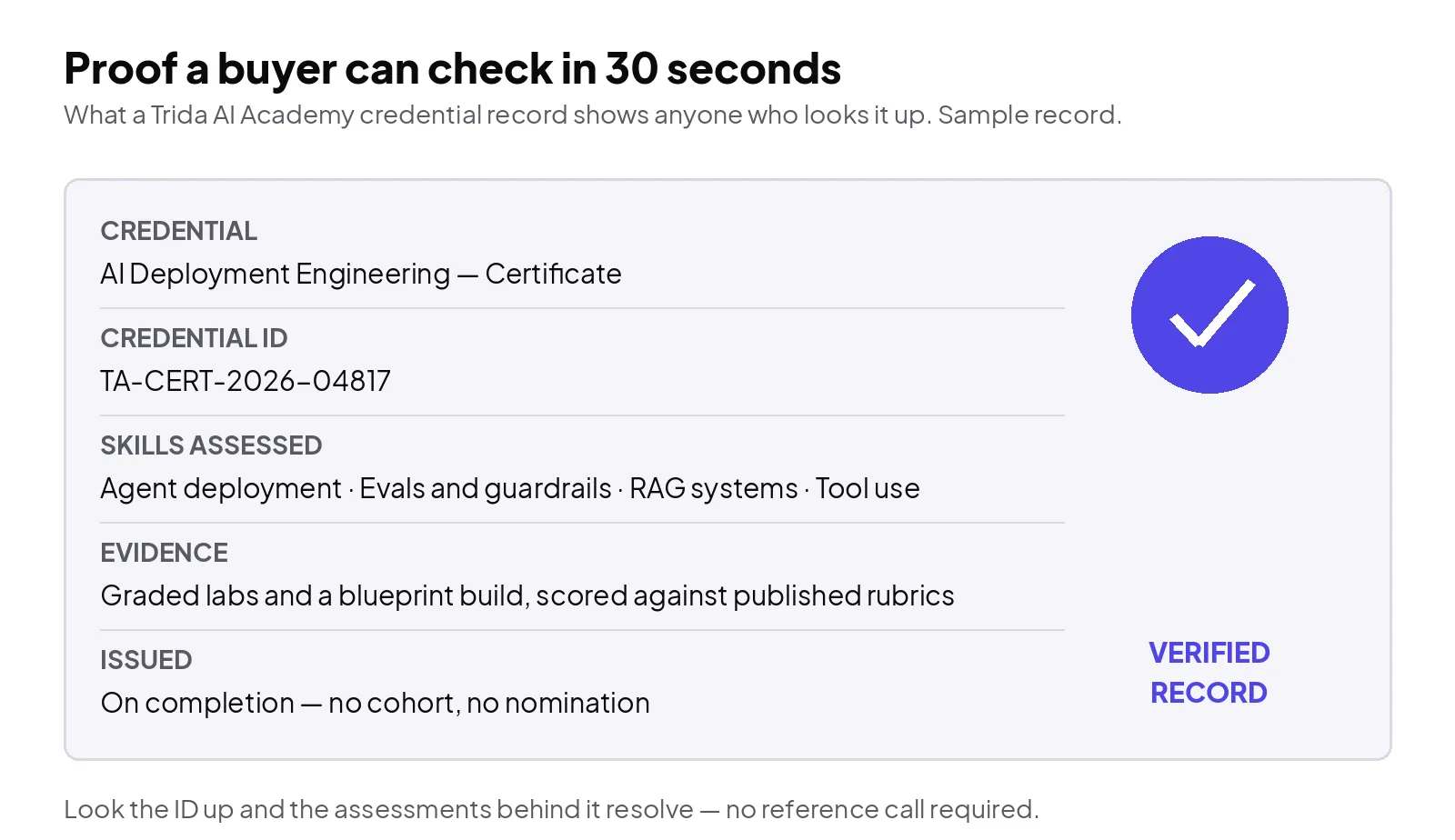
We built the Trida AI Academy on the opposite bet. It is free and open: any engineer can work through the courses and skill tests — readings, labs, assessments — and earn certifications themselves, in deployment skills that span models rather than one vendor's stack. Every credential carries a unique ID that anyone can verify, so the proof doesn't depend on taking our word, or anyone's. The Network then matches those engineers with companies, ranked by verified skill, with introductions reviewed by a person.
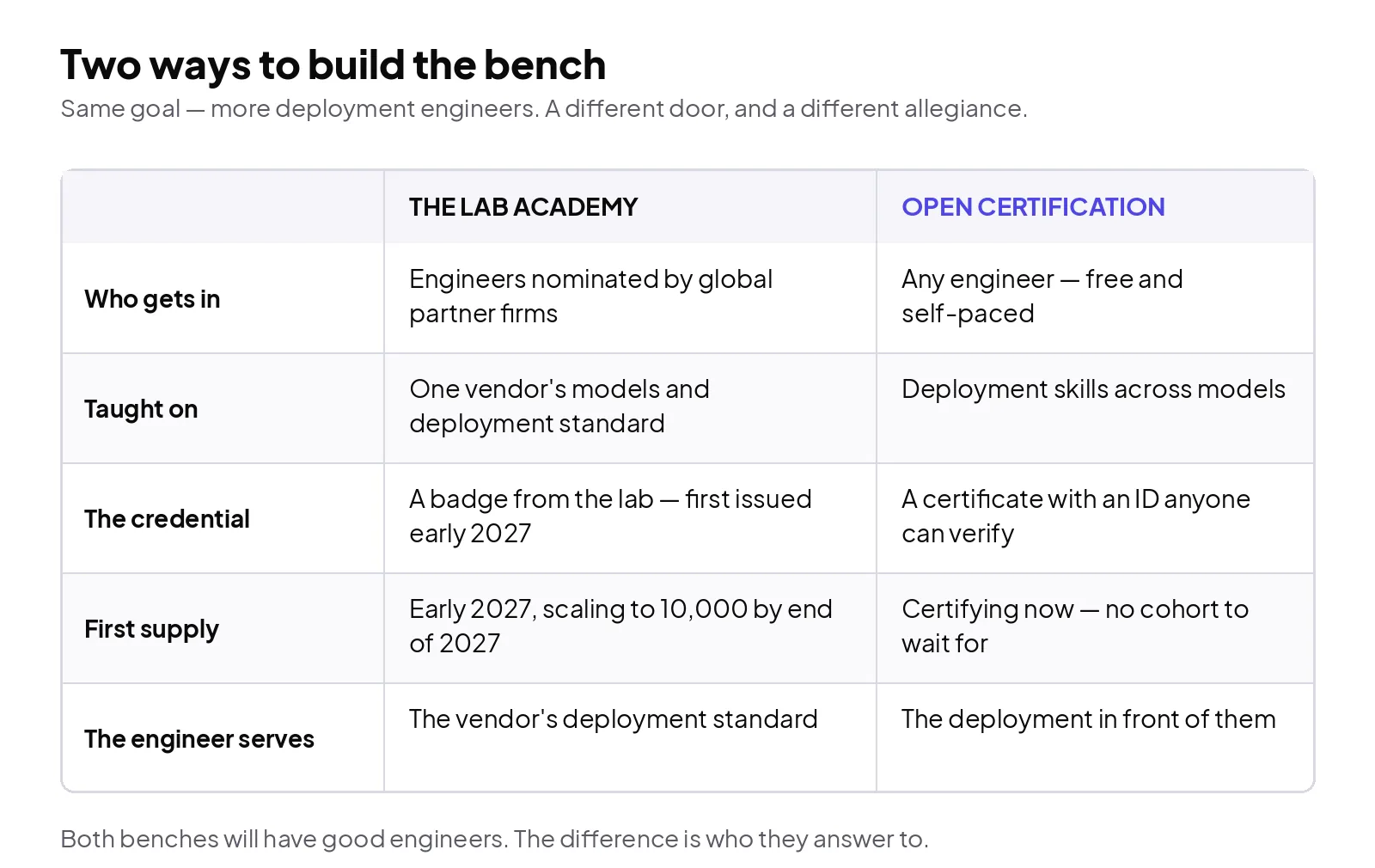
The difference that matters to a buyer isn't the curriculum. It's what the engineer owes and to whom. An academy run by a model company produces engineers whose craft is that company's model; that is its purpose, and it does it in the open. An independent certification produces engineers whose only commitment is to the deployment in front of them: free to tell you Claude is right for this workload, wrong for that one, and that a third should run on a model you own outright. Both benches will be staffed by talented people. Only one of them can give you an answer the vendor didn't pre-approve.
Where the lab academies are the right answer
Honesty about the boundary: for a global enterprise going all-in on one model, with a Big-Four firm already in the building, Anthropic's residency is probably the strongest training that exists for that stack, and the channel economics work in everyone's favor. The broader partner network behind it is already large — Anthropic counts more than 175,000 Claude certifications across 46,000 firms — so vendor certification at scale is real, not vapor. And a rising standard helps the whole field: every residency graduate makes "deployment engineer" a more legible hire for everyone, including us.
The gap is specific, and it's where most companies actually sit: outside the nomination list, running more than one model, hiring this year. That gap is not a criticism of the academy. It's just not the academy's job to fill it.
The question to ask any deployment partner
The labs are now competing on deployment capacity, which quietly settles what this industry is: a deployment industry with models in it. So the buyer's question changes. Not "which model should we buy?" The models are all capable, and the honest answer varies by workload. Ask instead: who is deploying it for us, what proof of skill can we check ourselves, and whose interests does that engineer serve when the model choice is genuinely open?
Get a good answer to that, and the model question usually answers itself.
Work with us
If you're hiring deployment engineers this year — or deciding who should deploy AI across your systems, on whichever models fit the work — start with proof you can verify, through Trida AI's intake.