
What Is Forward Deployed Engineering? The Playbook Behind AI That Actually Ships
The demo is not the product
A frontier model connected to a clean CSV will demo beautifully. Production is a different environment: data behind SSO and a permission model the model has to respect, documents in five formats and three decades of inconsistent naming, a system of record with no API for the one field you need, PII that cannot leave the VPC, and users who will abandon the tool after two wrong answers.
That is the finding of "The GenAI Divide: State of AI in Business 2025" from MIT's Project NANDA: despite $30–40B of enterprise spend, around 95% of organisations saw no measurable impact on their P&L. The models were not the bottleneck. The deployment was — the same study found projects delivered with external partners succeeded about 67% of the time, roughly double the rate of internal builds (~33%).
Forward Deployed Engineering (FDE) is the role built for that gap. A Forward Deployed Engineer is a senior engineer embedded inside the customer — committing to their repo, deploying into their cloud, sitting with their users — with one measure of success: a system running in production that the customer's own team can operate after the FDE leaves.
A short, specific history
The role was created at Palantir, whose data platform only created value once it was wired into a customer's actual operations — so its engineers were deployed "forward": on site, inside the problem, instead of shipping software from headquarters and filing tickets from afar.
For a decade it stayed a niche pattern. AI changed the maths. A SaaS product behaves identically in every company; an AI system's quality is a function of your data, your documents, your edge cases, and your definition of correct — so there is no generic deployment to ship. The work has to happen where the data and the users are. In 2026 the pattern went fully mainstream: OpenAI launched a dedicated deployment company with more than $4B of initial investment (May 2026), AWS stood up a $1B forward-deployed engineering organisation (June 2026), Microsoft committed $2.5B to Frontier Company, a deployment company of its own (July 2026), and Anthropic formed a deployment joint venture with Blackstone, Hellman & Friedman, and Goldman Sachs. The model Trida was built on — forward-deployed engineers inside the enterprise — became the industry's default answer in a matter of months.
It also helps to separate FDE from its neighbours. A solutions engineer supports the sales cycle and leaves after the contract. A TAM manages account health after the sale. A consultant delivers analysis and recommendations. An FDE owns a production outcome inside your environment, in code.
Staffing sends people. Consulting sends advice. FDEs ship systems.
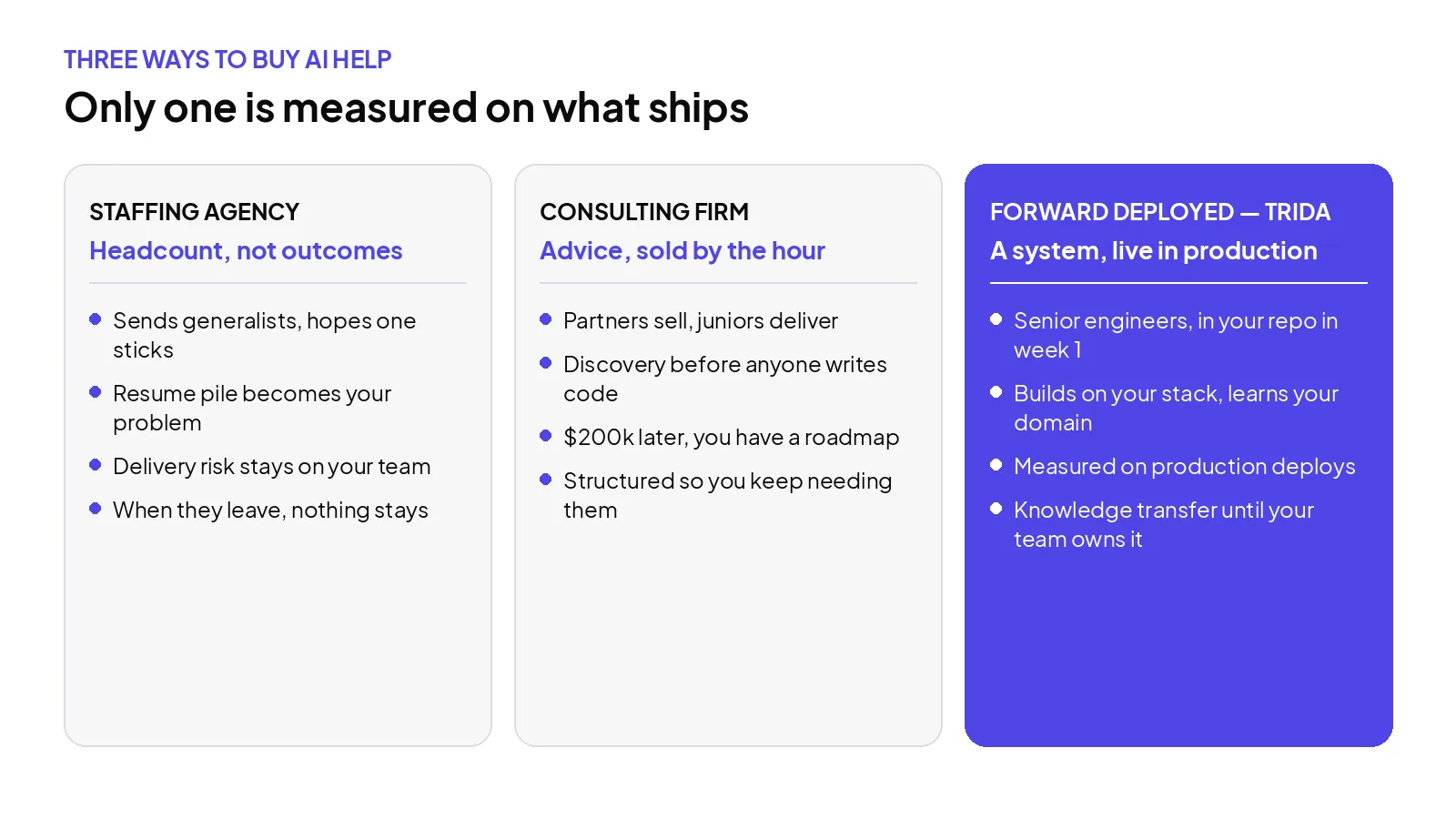
Staffing optimises for filled seats: you interview from a resume pile, carry the delivery risk, and lose the knowledge when the contractor rolls off. Consulting optimises for billable hours: discovery phases, a roadmap deck, and a system your team still has to build. A forward-deployed team optimises for one artifact — working software in your production environment — and for the transfer that makes it yours: paired work, runbooks, and training until your engineers extend the system without them.
What week one actually looks like
No discovery phase that ends in a PDF. A typical first week for a Trida FDE pod:
Days 1–2 — access and reality. SSO, repo access, CI, the observability stack, the data warehouse as it actually is (not as the architecture diagram claims). Shadowing the users who do the target workflow by hand today.
Days 3–4 — pick a thin slice. One workflow, end to end, small enough to reach production in weeks. Score candidates on value, data readiness, and integration surface — and say no, in writing, to the use cases that fail on data.
Day 5 — agree the bar before choosing a model. A golden eval set of 100–200 real examples drawn from tickets, documents, and call logs, with the answers your experts sign off on; a success metric a business owner recognises; and latency and cost-per-task budgets. Model selection comes after the eval exists, not before — otherwise you are benchmarking demos.
The loop, and the engineering inside it
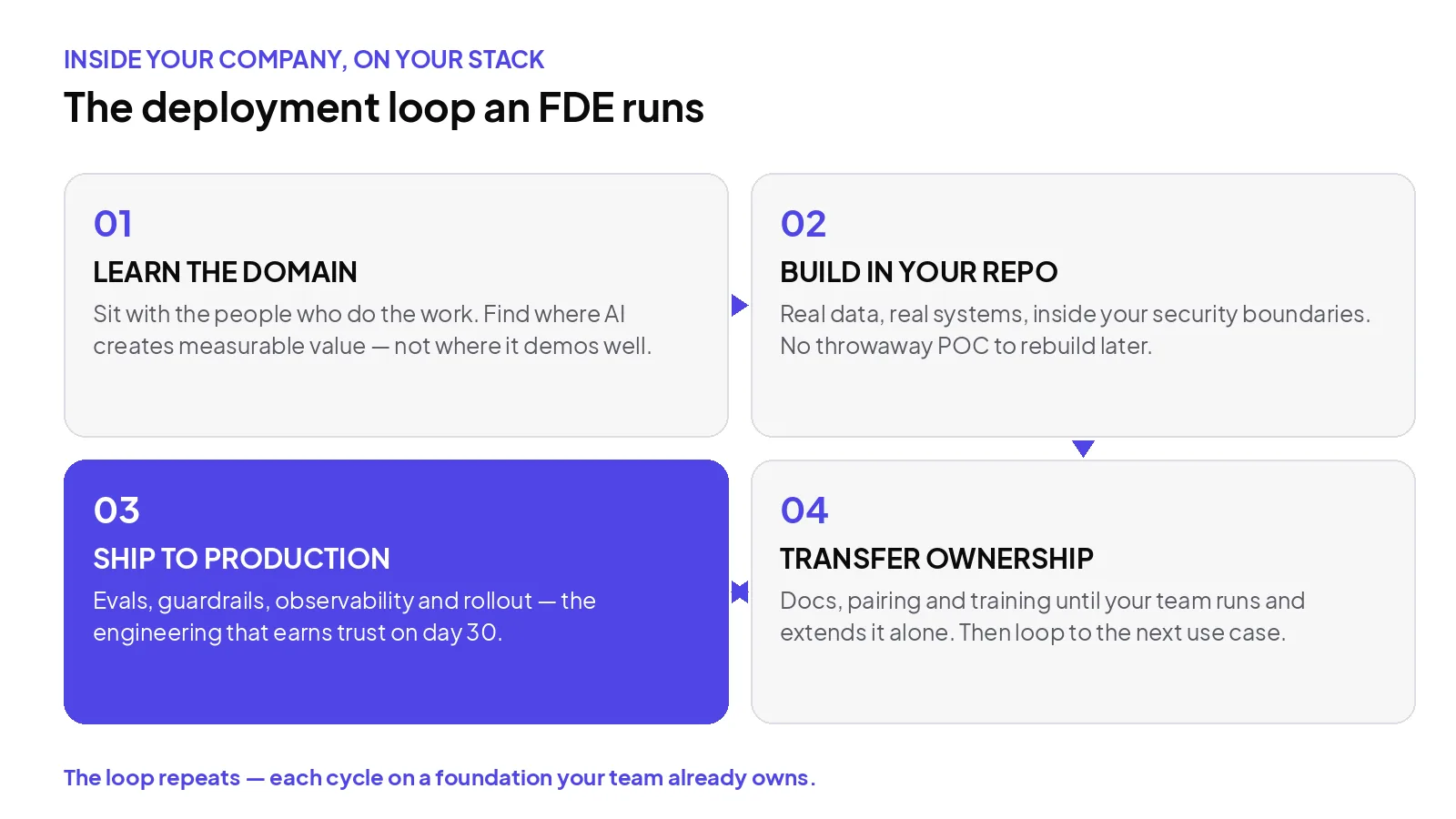
After week one the work settles into a loop — learn, build, ship, transfer — and the technical substance sits in "ship":
Evals as CI. The golden set runs on every prompt or model change; a regression blocks the merge like a failing test, because it is one.
Guardrails at the boundary. PII redaction before anything leaves your boundary, output validation, and policy checks enforced in code — not in the system prompt's good intentions.
Tracing on every call. Prompt, context, tool calls, latency, and cost logged per request, so "the AI is wrong" becomes a debuggable trace instead of an opinion.
Staged rollout. Shadow mode against live traffic, then a canary cohort, then a percentage ramp — with a fallback to the human queue at every stage and a kill switch someone on your team has actually tested.
A runbook, not a hero. On-call notes, failure modes, and retraining/eval refresh cadence handed over with the code.
None of this is model work. All of it is what decides whether the system is still trusted on day ninety.
Why good FDEs are hard to hire — and how we staff them
The role demands production engineering depth, product judgement, and the credibility to tell a stakeholder their favourite use case is sequenced wrong. Keyword-matched resumes do not predict any of that. Trida staffs deployment teams from the Trida Network, where engineers are ranked by verified skill — hands-on Academy labs and assessments with verifiable credentials — rather than by what their CV claims. Evidence over keywords is the only hiring filter that survives contact with a real codebase.
When not to use one
Forward deployment is the wrong spend when a standard SaaS product already solves the problem, when the data does not exist yet, or when you need hands for well-specified tickets — that is staffing, and it is cheaper. It is the right spend when the workflow is valuable, the systems and data are yours, and the risk lives between the demo and production.
Before engaging anyone who claims this model, ask:
Repo — will your engineers commit to our repo, through our CI and review?
Eval — show us the golden set and the last regression it caught.
Boundary — where does our data go, exactly, and what enforces that?
Rollout — what does the path from shadow mode to 100% look like, and who can roll it back?
Exit — on the last day, what do we own — code, evals, runbooks, and the skill to run them?
A model gives you intelligence. Forward deployment gives you a system in production, owned by your team. The distance between those two things is the whole job.
Bring us a problem. Trida AI's intake is a few questions, then a talk with founders and experts from Trida AI — no sales call to get to a sales call.