
Software Doesn't Need Sentences: Jev, System One Models, and the Decision Layer
On 15 September 2026, TypeSafe AI came out of two years of stealth with a $40M seed round led by DCVC and a claim the industry has been circling for years: the problem with LLMs in production isn't intelligence. It's the interface. An LLM hands your software a string — brilliant, flexible, and impossible to depend on. Somebody still has to parse it, validate it, retry it, and catch the day it quietly returns a value your schema never allowed.
TypeSafe's answer is Jev, the first of what it calls System One Models — named for the fast, intuitive "System 1" of Daniel Kahneman's Thinking, Fast and Slow. The company was founded by Diogo Almeida, a co-author of InstructGPT, the work that taught ChatGPT to follow instructions. His bet is the opposite of the one the rest of the industry is scaling: don't make the model deliberate longer. Make it decide faster, in a shape software can consume directly — "a frontier-intelligence function call: unstructured state in, typed probabilistic decisions out."
We deploy AI into enterprise workflows for a living, and this is the first model launch in a while that is aimed at the layer where our projects actually succeed or fail. So we read the launch post, the documentation and the published eval code carefully. Here is what's real, what's marketing, and what it changes.
What Jev actually is
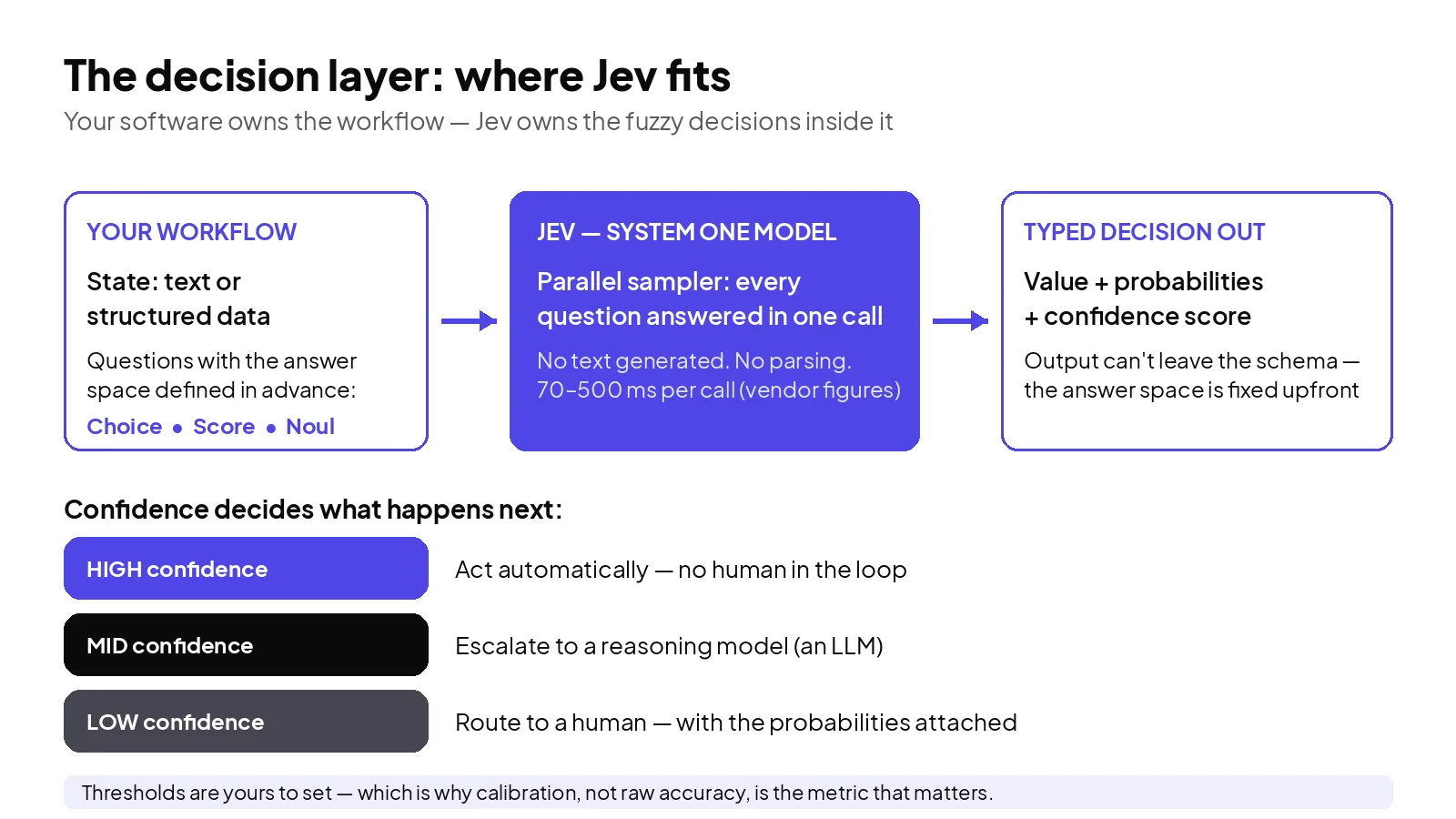
Jev does not generate text. There is no chat, no completion, no chain-of-thought to read. You call one endpoint with two things: a state (text or structured data describing the situation) and a set of questions, where every question defines its own answer space in advance. The current model, jev-1.13.0, answers all of them in a single call.
The questions come in three primitives:
Choice — pick one option from a list you define (up to 255 options), returned with a probability for every option and a confidence score.
Score — rate against an ordered scale of 2–10 levels you describe; the returned score is probability-weighted, so it can land between levels.
Noul — a yes/no question, returned as a single probability.
Because the answer space is declared up front, the model physically cannot return a value outside it — which is where the "can't hallucinate" claim comes from, and we'll take it apart below. Sampling is parallel rather than autoregressive: the state is ingested once, every question is evaluated in the same pass, and TypeSafe's docs note that adding more questions barely changes latency. The trade is absolute, though. Jev gives up string generation entirely — no explanations, no reasoning trace, just distributions over answers you enumerated. As developer Simon Willison put it, you get back a float, and the reasoning that produced it stays inside the black box.
Two operational details matter for anyone costing this out. First, there is no fine-tuning: the same weights serve every customer, shaped only by your state, instructions and criteria, and TypeSafe says the model is trained exclusively on synthetic data, never on customer data. Second, the limits are real — 64k tokens per request, text only. This is a decision component, not a general-purpose model.
"Can't hallucinate" — read the guarantee carefully
The guarantee is narrower than the headline, and TypeSafe, to its credit, says so in its own fine print: "Our number is not empirical. Schema matching is guaranteed." What is guaranteed is schema conformity — the output is always a well-typed distribution over the options you supplied. Zero type errors, zero malformed JSON, zero unparseable responses, forever, by construction. Anyone who has run LLM structured output in production knows that failure class intimately: the model that returns "high" when your enum says HIGH, the tool call with a hallucinated field, three layers deep in a dependency chain where nobody sees it until the invoice run.
What is not guaranteed is that the model picks the right valid value. A Choice question can return a perfectly typed, confidently wrong classification. As Armin Ronacher told TechCrunch, Jev "delegates the hallucination problem a little bit to the user" — because the user now owns the answer space. If your options are badly drawn, Jev will choose among them flawlessly.
It is also worth knowing this guarantee has prior art. OpenAI's Structured Outputs and open-source constrained decoding such as Outlines already force LLM output to match a schema by construction. Jev's difference is that the constraint is native rather than bolted on — no token masking, no retries on malformed output (TypeSafe's own adapter for LLMs has to renormalise invalid distributions and retry malformed responses; Jev never produces them) — and that you get the full probability distribution, not a single sampled answer. Whether that difference is worth a new model class is the real question, and it's an empirical one.
The number that matters is calibration
Strip away the speed claims and Jev's most consequential design decision is its training objective. LLMs are trained with RLHF (optimise for what human raters prefer) or RLVR (optimise for answers that can be checked). Jev is trained with what TypeSafe calls RLCD — Reinforcement Learning for Calibrated Decisions: optimise so that when the model says 0.8, it's right about 80% of the time.
Every Jev answer carries its probabilities plus a confidence figure — which, the docs are careful to note, is not the probability itself but a deterministic statistic of how concentrated the distribution is. That distinction is exactly right, and it matters operationally. Automation doesn't fail because a model is wrong sometimes; it fails because the model can't tell you when it's likely wrong. A decision call that honestly returns 0.55 can be routed to an LLM or a human. A chat model that is wrong with total rhetorical confidence gets wired straight into the workflow, and you find out in production.
Here is the scrutiny point: calibration is a measurable claim, and the field has yardsticks for it — expected calibration error, Brier scores, a literature running from Guo et al.'s 2017 finding that modern neural networks are poorly calibrated, to Tian et al.'s 2023 result that RLHF models' stated confidences beat their token probabilities but remain overconfident. TypeSafe publishes no calibration metric for Jev at all — no ECE, no Brier score, no reliability diagram. RLCD may well deliver what it promises, but today "calibrated" is a design goal with a plausible mechanism, not a verified measurement. If you adopt Jev, measure calibration on your own golden sets before you let a threshold make decisions unsupervised. That was true for LLM confidence scores, and it stays true here.
The receipts, and their limits
The headline numbers are dramatic: end-to-end responses of 70–500ms against 3–329 seconds for frontier LLMs; input priced at $0.042 per million tokens with output tokens free; and, from TypeSafe's homepage, workflow results of 193.6x faster and 444.6x cheaper. The pricing is public and checkable — it's the strongest claim in the launch. The speed is plausible for a parallel sampler with no autoregressive decoding, though TypeSafe notes its evals were run from laptops on the US West Coast, near its servers.
The 193.6x / 444.6x figures need their context. They come from TypeSafe's own workflow evals: four workflows (security incidents, agent-trace observability, invoice processing, customer service; 705 cases in the published code), where there is no ground truth — scores measure agreement with a reference defined as the average of GPT-6 Astra and Claude Fable 5.1. TypeSafe discloses the biases itself: the workflows were built by its own team, and the reference "biases answers towards OpenAI and Anthropic's models." It also says, in its own launch post, that these numbers "are on the higher end of real world gains." Independent field reports in TechCrunch's coverage land an order of magnitude lower and still impressive — roughly 5–18x faster at Vercel, 10–20x cheaper at Bryo with slightly lower accuracy. And one independent transcription of TypeSafe's own evals dashboard puts Jev's aggregate agreement with the reference at 67.8%, below the top LLM's 74.1%: on today's evidence Jev wins on cost and time, not on matching the big models answer-for-answer. That is a perfectly good trade for a decision layer — as long as you buy it with your eyes open.
Where it breaks
Unusually for a launch, the sharpest limitations are documented by TypeSafe itself. Its jaggedness notes for the current model describe a system that reads state literally, is unreliable at counting, maths and dates, suffers context rot on long inputs, can be steered by adversarial content inside the state, shows sensitivity to the order you list options in, and — critically for anyone writing tests against it — is not deterministic: probabilities wobble between identical calls. None of that is disqualifying. All of it defines the shape of work Jev is for: many small, decomposed, independent decisions, each with an enumerated answer space, inside a workflow whose structure a human designed — not open-ended judgement, and never arithmetic.
What this changes in production
The deepest idea in the launch is not the model — it's the Jevons paradox the model is named after. William Stanley Jevons observed in 1865 that making steam engines more efficient increased total coal consumption, because cheaper power created new uses. TypeSafe's wager: when a reliable decision costs a hundredth of an LLM call and returns in 100ms, you don't make the same number of decisions more cheaply — you make orders of magnitude more of them. Their toy proof is a Doom bot querying game state ten times a second for about $7 an hour. The serious version is classifying, scoring and routing at data scale — the "verify everything" pattern, where a fast, typed judge scores prompts, reasoning traces and outputs of slower generative models. That pattern has research pedigree — trained verifiers judging generator outputs beat bigger generators back in 2021 — and Jev is its first serious productisation as a standalone layer.
For deployment work, the implication is a shift in where the engineering hours go. If Jev-class models hold up, the scarce skill is no longer prompt-wrangling a chatbot into returning parseable JSON. It's decision design: decomposing a business process into the right questions, drawing answer spaces that cover reality without gaps, setting confidence thresholds, and building the escalation paths — to a reasoning model, to a human — for everything below them. Get the decomposition wrong and you have automated the wrong decision at magnificent speed. That decomposition is unglamorous, domain-specific, and exactly where enterprise AI projects are won or lost. It's also, not coincidentally, the work forward deployed engineers do.
When is Jev the wrong tool? Anything that needs generated language, long deliberative reasoning, maths, or an answer space you can't enumerate in advance. Jev doesn't replace the reasoning model; it demotes it — from doing every fuzzy judgement itself, slowly and in prose, to handling the escalations a cheap decision layer routes to it.
Bring us a problem
Jev is in early access, its boldest numbers are vendor-run, and its calibration claim is still unmeasured in public. And still: a typed, probabilistic, 100-millisecond decision primitive is the most interesting new building block production AI has had in years. If you're designing workflows where LLMs are too slow, too expensive, or too loosely typed to trust, start with Trida AI's intake — a few questions, then talk with founders and experts from Trida AI.