Shadow Mode Before Go-Live
The most useful week of a deployment may be the one where the new system is not allowed to do anything.
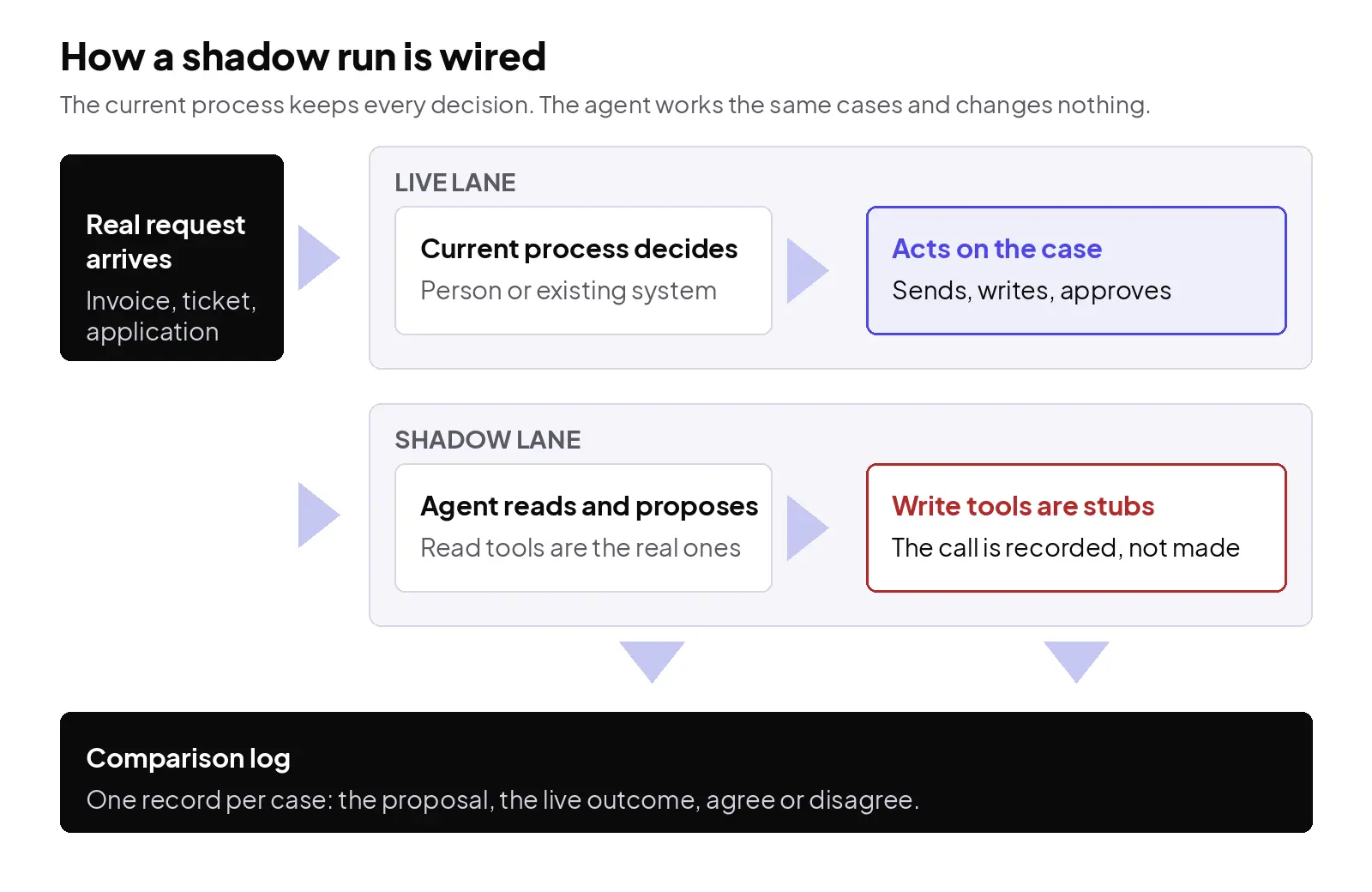
That sounds like a delay tactic. It isn't. An eval runs the agent against cases somebody selected last month. A demo runs it against cases somebody selected that morning. Real work arrives unselected: the malformed record, the customer who writes in paragraphs, the approval that depends on a rule nobody wrote down. Shadow mode is how you meet that traffic before the traffic meets your agent. A copy of each real request goes to the new system. The current process (a person, an older system, a mix) still makes every decision and still does the work. The agent reads, reasons and proposes. It sends nothing, writes nothing, approves nothing. Its proposals are logged next to what actually happened, and the comparison is the deliverable.
The pattern is borrowed, and the borrowing is the point. In model serving, Amazon SageMaker AI runs a candidate variant in shadow mode: it receives a copy of live inference requests in real time, only the production variant's responses go back to the caller, and the shadow's responses are logged or discarded for offline comparison. Teams use it to catch configuration errors and performance problems before end users feel them. An agent deployment needs the same discipline with one harder twist. A model returns a prediction. An agent reaches for tools. Shadowing the prediction is easy; shadowing the reaching is the design work.
Tying its hands is the design work
A shadow agent that can act is not in shadow mode, whatever the slide says. So the run is built in two halves. Read access is real: the agent queries the same systems, retrieves the same documents and sees the same record the current process sees, because sanitized copies teach it a tidier world than the one it will work in. Write access is replaced. Every side-effecting tool (send, post, update, approve) is swapped for a stub with the same interface that records the call it would have made: the arguments, the target, the moment in the run. The agent cannot tell the difference from inside. From outside, the difference is total.
What gets logged per case matters more than how much. You want the input reference, the proposal in full (the draft message, the intended update, the chosen route), the live outcome when it lands, and a plain agree-or-disagree mark between the two. Not a score. A join. Scores tell you the shadow period went well or badly; the joined record tells you where, and on what kind of case, and that is what a go-live decision is actually made of.
Run it long enough to see the work change shape. A shadow week that covers only quiet midweek traffic has tested the agent against the easiest slice of the job. Month-end, the weekly batch, the day the upstream system sends its corrections: the calendar is part of the test set, and a deployment that has not shadowed through at least one full cycle of its workflow's calendar has a known hole in its evidence, whether or not anyone says so out loud.
Read the disagreements, not the agreement rate
Agreement is the seductive number and the weaker one. If the agent agrees with the current process 94% of the time, you have learned that it resembles the current process. Where the current process is wrong, and every process has a drawer of cases it handles badly, agreement is the agent faithfully learning the flaw. So sample the agreements as well as the fights. Two sides can be wrong together, in the same direction, and a case with no disagreement on it looks exactly like a correct one until somebody checks.
The disagreements are where the information sits. Worked through one by one, they sort into three piles, and the piles have different owners. Cases where the agent was wrong: a missing rule, a misread document, a retrieval that found the policy and not its exception. Cases where the agent was right and the live decision was the error the team already suspected but could never catch in the act. And cases where neither was wrong, because the workflow quietly allows two defensible answers and nobody had ever had to pick one and write it down. That third pile is the sleeper. Shadow mode forces the undocumented judgment calls into the open while they are still cheap to settle, argued over a logged case instead of a live incident.
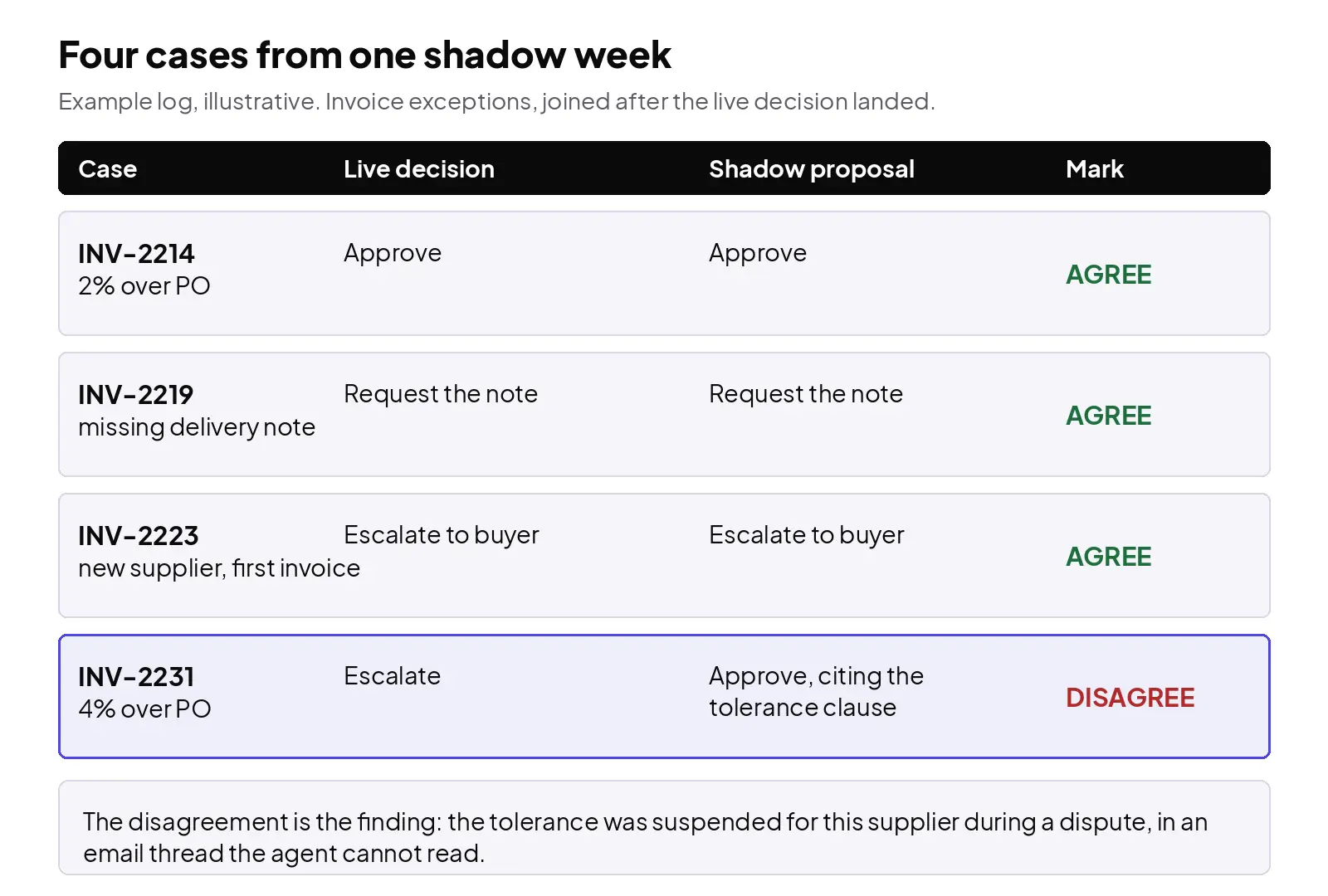
Take an example, invented but built from ordinary parts. An agent shadows an invoice-exception queue. The live clerk escalates an invoice priced 4% above its purchase order. The shadow proposes approving it, citing the tolerance clause it retrieved. Both read the same contract. What the clerk knows, and the clause does not say, is that the tolerance was suspended for that supplier during a dispute the previous quarter, a fact living in an email thread, not in any system the agent can read. That single disagreement is worth more than the week's agreement rate. It names a source that has to be connected, or a rule that has to be written, before go-live, and it was found without a wrong approval reaching the supplier.
What shadow mode cannot tell you
It cannot tell you how people react. Nobody works with the shadow's output, so there is no evidence about trust, override habits or the alert fatigue a chatty agent creates. It cannot validate decisions whose ground truth arrives weeks later (a credit call, a churn save) because the live outcome it joins against is itself provisional. And it costs real money and real care: a second inference pass over live traffic, on data that now sits in one more log, with retention and access rules that need deciding before the shadow starts, not after it ends.
So shadow is a stage, not a destination. The step after it exposes real users to the new system on a small slice of traffic. Google's SRE workbook describes it as canarying releases, a partial, time-limited deployment whose evaluation decides whether the rollout proceeds. The order matters. Canary answers "does it hold up when it acts?" Shadow answers the earlier question — "does it even see the work the way the work actually is?" — and it answers it at a price of zero wrong actions. Skipping straight to canary means paying for that first answer with real mistakes on real cases.
Work with us
If your agent is headed for production on the strength of a demo and an eval set, there is a cheaper week available first: one where it does the real work on paper and the disagreements get read before customers read them. Bring us the workflow you are about to hand over, through Trida AI's intake, and we will help you run it in shadow before it runs for real.