
Managed Agents Move Inside Your Perimeter
Picture the security review for an agent that works unattended. It reads your code, opens your internal systems, fixes a broken build at an hour when nobody is watching. The reviewer's question is not whether the model is good. It is where all of this runs, who holds the credentials it uses, and where the record of what it did ends up. Until recently, the managed answer stopped partway. You could host the sandbox an agent's tools ran in, but the service around it — the loop, the credentials, the session history — stayed on the vendor's infrastructure. That is starting to change.
On 12 November, Anthropic opened self-hosted Claude Managed Agents in private beta. The offer is broader than it may sound. This is not a sandbox you host while the vendor keeps the rest. Every part of the service runs in your own cloud or on-premise: the harness that drives the agent, the sandboxes where its tools run, credential handling, and session history. You operate the Managed Agents server, its database, and the workers where agents run their shell and file tools. Your developers build against the same core APIs as the hosted service.
That last detail matters more than the hosting itself. The API staying the same means the choice of where an agent runs is becoming a deployment decision, taken per workload, rather than a platform decision taken once. An agent that summarises public documents can stay hosted. An agent that touches the build system and the alert queue can move inside. The work of choosing moves to you, which is where it belonged anyway.
What moved, and what stayed outside
It helps to be precise about the split, because "self-hosted" invites a misunderstanding. The model did not move. Model requests go where you choose: Anthropic directly, Amazon Bedrock, Google's Agent Platform, Microsoft Foundry, or your own gateway. What moved is everything around the model: the loop that decides what to do next, the place where code executes, the vault the credentials sit in, and the history of the session.
Anthropic's design keeps two of those pieces apart even inside your perimeter. The harness, the brain, calls the model. The sandbox, the hands, is where the agent's code actually runs. Credentials stay out of the sandbox: for MCP tools and supported API calls, a proxy outside it adds the credential to the request, and in the self-hosted setup you can also store credentials in your own secrets manager. Network access can be limited to a list of allowed hosts — for a build-fixing agent, perhaps just your git host and your package registry. And every session leaves a full record of the steps the agent took, exportable over OpenTelemetry into the monitoring tools you already run.
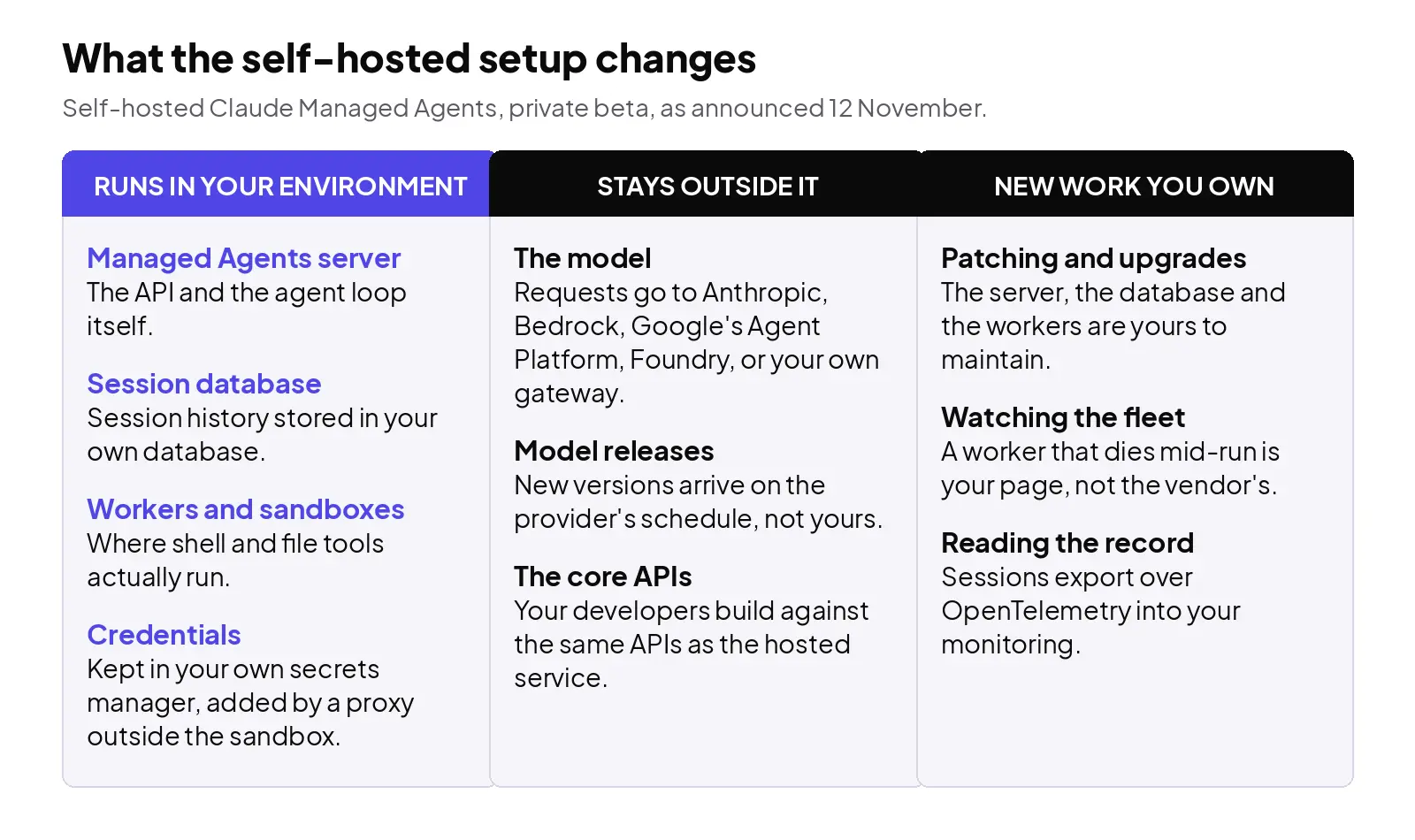
Read that inventory as a trade, not a gift. In exchange for keeping credentials and session history inside your own boundary, you take on a server, a database and a fleet of workers. Somebody on your side patches them, watches them, and answers when a worker dies mid-run at an awkward hour. The hosted service existed precisely to make that somebody the vendor's problem. Self-hosting does not remove the operating work. It repatriates it, and a team should price that honestly before it celebrates the control it just gained.
One run, traced across the line
Take an illustrative run: an agent triaging an overnight alert, reading the failing service's recent changes and opening a fix. Traced step by step, the perimeter line cuts through the middle of the work, not around it.
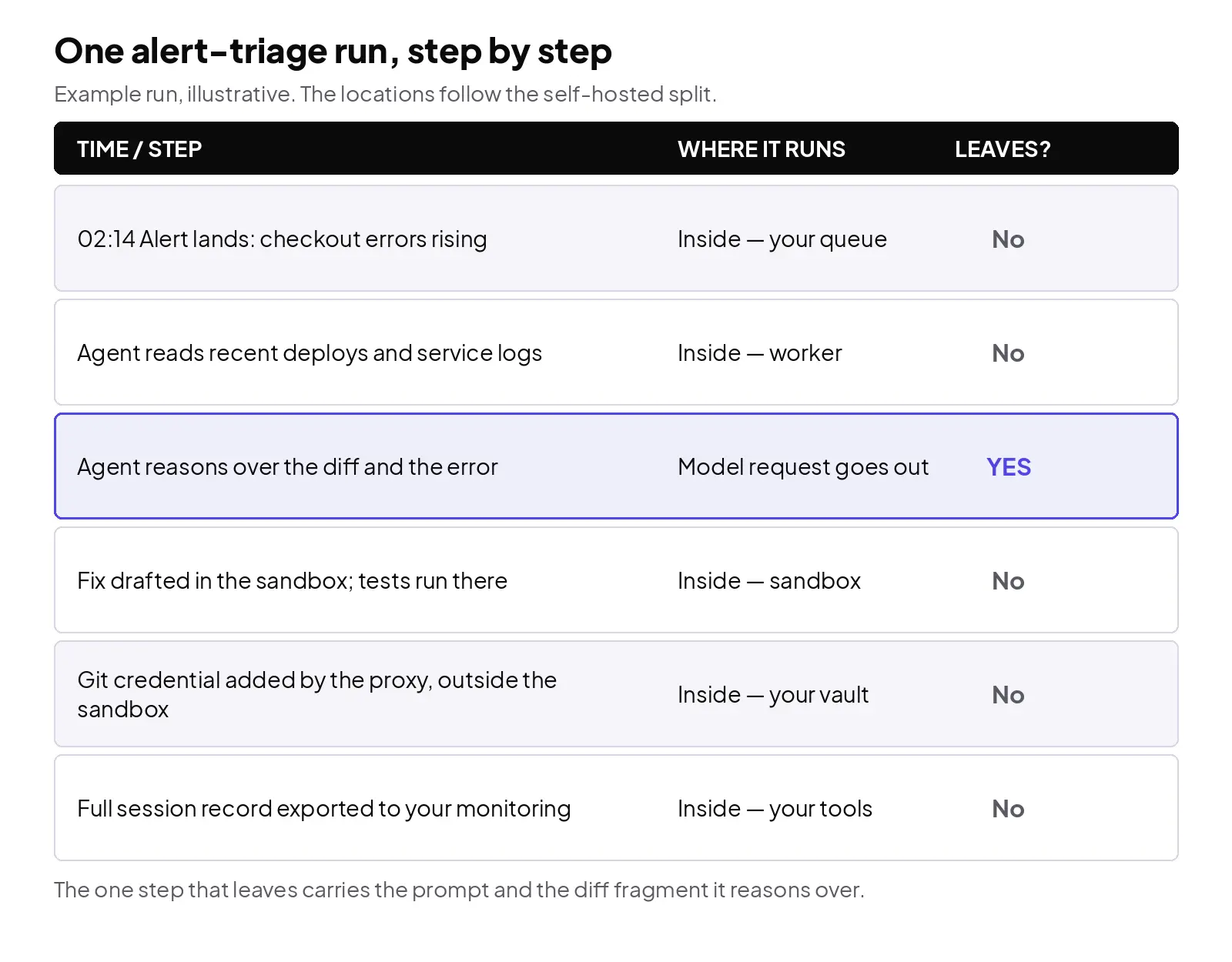
Two things stand out in the trace. The code stays in the sandbox, the credentials stay in the vault, and the session record stays in your database. And the thing that does leave, the model request, leaves whenever the harness calls the model. Prompts carry context, and context is often the sensitive part: the diff, the error, the fragment of the internal document the agent is reasoning over. Anthropic notes that where you have zero data retention in place with it, that arrangement applies to the requests sent to the model in the same way as any other Messages API call. That is a real protection, and it is also the boundary of the claim. A self-hosted agent is not an offline agent, and any review that treats it as one has misunderstood what was bought.
There is a second limit, easier to miss. A private beta is a promise about direction, not a finished platform, and access runs through an account team. The right first questions are the operational ones: who patches the server, what happens when a worker dies mid-run, how the record reaches your monitoring. None of that argues against the direction. It argues for putting the first self-hosted agent on work that is important enough to justify the operating cost and contained enough to survive a beta.
Work with us
If an agent you want to run keeps failing its security review on where it lives — where its credentials sit, where its session history lands — that is now a design question with more than one answer, and the operating cost of each answer deserves a clear-eyed count before you choose. Send the workload through Trida AI's intake and we will work through the split with you: what has to stay inside, what can stay hosted, and who operates what.