
Forward Deployed Engineering FAQ
The demo worked. Then the room went quiet, and someone asked the question that decides whether anything happens next: "So what would this actually look like here?"
Buyers ask a version of that question in almost every first conversation, and the follow-ups are remarkably consistent. They are not really asking about models. They are asking about trust: where the system will run, who owns what it produces, and how anyone will know it is good enough. These are the questions, with the answers we give before any engagement starts.
What does a forward deployed engineer actually do?
A forward deployed engineer is an engineer who embeds with your team and ships AI into production in your own environment. The unit of work is not advice, and it is not a prototype. It is a workflow your people already do, reviewing documents, answering a recurring class of requests, checking one system against another, rebuilt so the model does the parts it is good at, inside the tools and permissions your team already uses.
Most of the job is unglamorous engineering around the model: connecting it to the data it is allowed to see, handling the messy inputs the demo never showed, deciding what happens when the output is wrong, and logging enough that a failure can be traced. The model is one component. The deployment is the product.
How is this different from a consultant, or from hiring contractors?
A consultant's deliverable is usually a recommendation. A contractor's deliverable is usually hours, directed by you. A forward deployed deployment is accountable for a different deliverable: one named workflow, running in production, that your team uses without us in the room.
The difference shows up in who carries the integration risk. If the system only works while the vendor's engineer is watching it, it has not deployed. Our work is organised around that test. The pod (the small team that carries a deployment) succeeds when the workflow survives a normal Tuesday: the absent approver, the scanned document, the request phrased in a way nobody anticipated.
What problem should we bring first?
Bring one workflow, not a transformation programme. The first deployment earns or loses the trust that funds everything after it, so choose for evidence rather than ambition. A good first candidate happens often, hurts when it is slow, can be checked by a person who knows the work, and has edges you can describe: a start, an end, and a clear owner.
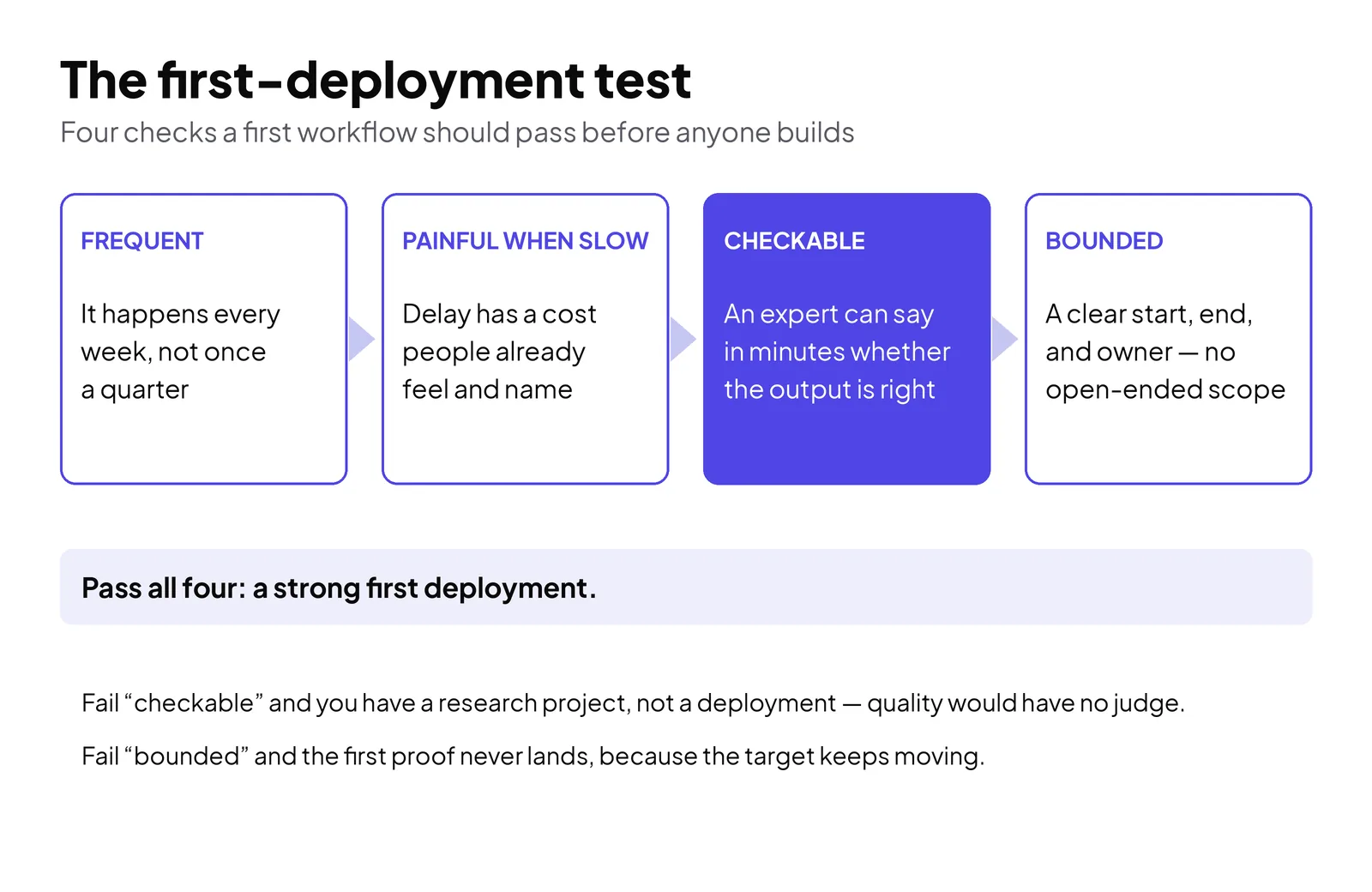
"We want to use AI across the business" fails that test in every direction. "Our team spends most of Monday reconciling these two reports by hand, and a senior person can tell in minutes whether the result is right" passes it. Scope is not a lack of ambition. It is how the first proof becomes believable.
Where will the system run, and what happens to our data?
In your environment, under your rules. The deployment runs in your cloud, your virtual private network, or on premises, as your architecture requires, and your data stays subject to your residency, retention, and access policies. The system sees the data its task requires, acts within the authority you grant it, and logs its actions where your team can review them.
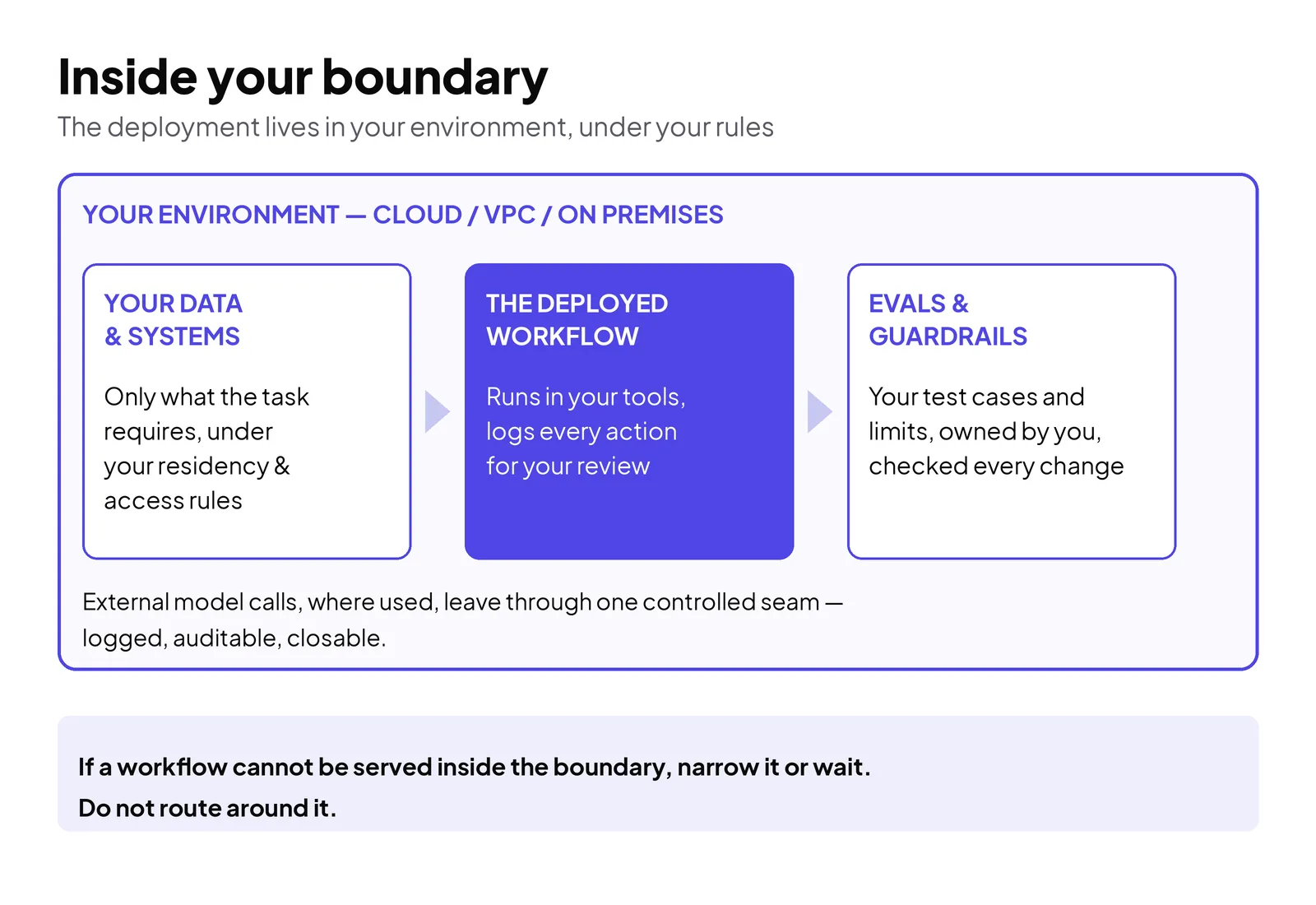
If your security review requires a data-processing agreement or evidence of how access is controlled, that conversation belongs at the start, not after the build. Some deployments will not survive it, and finding that out early is a good outcome for both sides. Where a workflow cannot be served within your boundary with the controls you need, the honest answer is to narrow the workflow or wait.
Which model will you use?
The one that performs best on your workload, measured on your examples. We are vendor-neutral, so we do not arrive with the model already chosen. Extraction from messy documents, drafting in a house style, and classifying requests reward different things, and vendor benchmarks cannot rank them on your data.
The choice is made with an eval set, a collection of real examples from the workflow with the answers your experts accept, run against the candidates. Published guidance on evals for AI agents makes the same underlying point: define the task and its success criteria first, then measure. The eval set stays yours, which makes the next model change a routine comparison instead of a fresh argument.
How will we know it is good enough for production?
The same way you know any production system is ready: against criteria written down before the launch decision, tested on the cases that actually occur, including the ugly ones. The eval set covers the common path and the known failure shapes. Guardrails (the in-line checks that constrain what the system may read, send, and do) handle the cases where a confident wrong answer would do damage. The system can draft but not send, propose but not approve, act below a threshold and escalate above it.
Readiness also includes the exit. A staged rollout means a small group uses the system on real work first, failures are reviewed while the volume is survivable, and expansion follows evidence. If the evals say the system is not ready for the full workflow, the deployment narrows or stops.
What do you need from our team?
Less than most programmes ask, but specific things. A sponsor who can clear a blocked decision. Access to the systems and documents the workflow touches, arranged through your normal security process. And time from the people who do the work today, not to manage the project, but because they hold the judgment the eval set has to capture: which answers are right, which errors matter, which cases should never be automated at all.
What we do not need is a committee designing the system in advance. The fastest way to learn what a workflow involves is to build against its real version, with the people who do it correcting the result.
What do we own at the end?
The deployment. The prompts, the eval set, the guardrail rules, the traces that explain the system's behaviour, and the documentation your team needs to run and change it. These live in your repositories, in forms your engineers can read without our tooling. Models will be replaced over the life of a system; those assets are the durable part, and a deployment you cannot inspect, modify, or move is one you have rented.
Handover is part of the work. Your team should be able to answer, without calling us: what does the system do, where does it fail, and what changed in the last update?
What does it cost, and how is it scoped?
Against a written proposal for a defined scope: one workflow, a stated production target, and the responsibilities on both sides set out before work begins. We do not price from a slide, because the honest cost depends on things discovery has to surface first: the state of the data, the systems involved, the controls required. Anyone quoting a firm price before looking at those is quoting for a different job.
When should we not hire a forward deployed team?
When the workflow cannot be defined, cannot be checked, or cannot be allowed to touch the data it needs. When nobody inside owns the outcome after go-live. When the real goal is a demonstration for its own sake: a pilot built to be shown, not used, will produce exactly that.
There is a simpler version of the same test. If you cannot name the person who will complain first when the system is wrong, the deployment has no feedback loop yet. Find that person first. Then the rest of these questions get much easier to answer.
Work with us
If you're weighing whether a forward deployed engineer fits your roadmap, start with Trida AI's intake — a few questions about your workflow and environment, then talk it through with founders and experts from Trida AI.