
CX Resolution Agent Blueprint
A support chatbot is usually graded on how the conversation felt. Did it sound helpful? Was the customer polite at the end? Meanwhile the things that actually cost a telecom operator money and trust sit outside the grade: a credit promised but never applied, a dispute waved through on a story, a customer who asked for a person three times and got a script.
This open blueprint, the CX Resolution Agent, is built around a stricter idea: a support agent should be judged on what it did. Every conversation has one accountable owner. Money moves only on evidence, under written caps. Identity is proven before anything consequential happens. And the moment a conversation should leave the agent, it leaves, by rule rather than by vibes.
One conversation, one owner
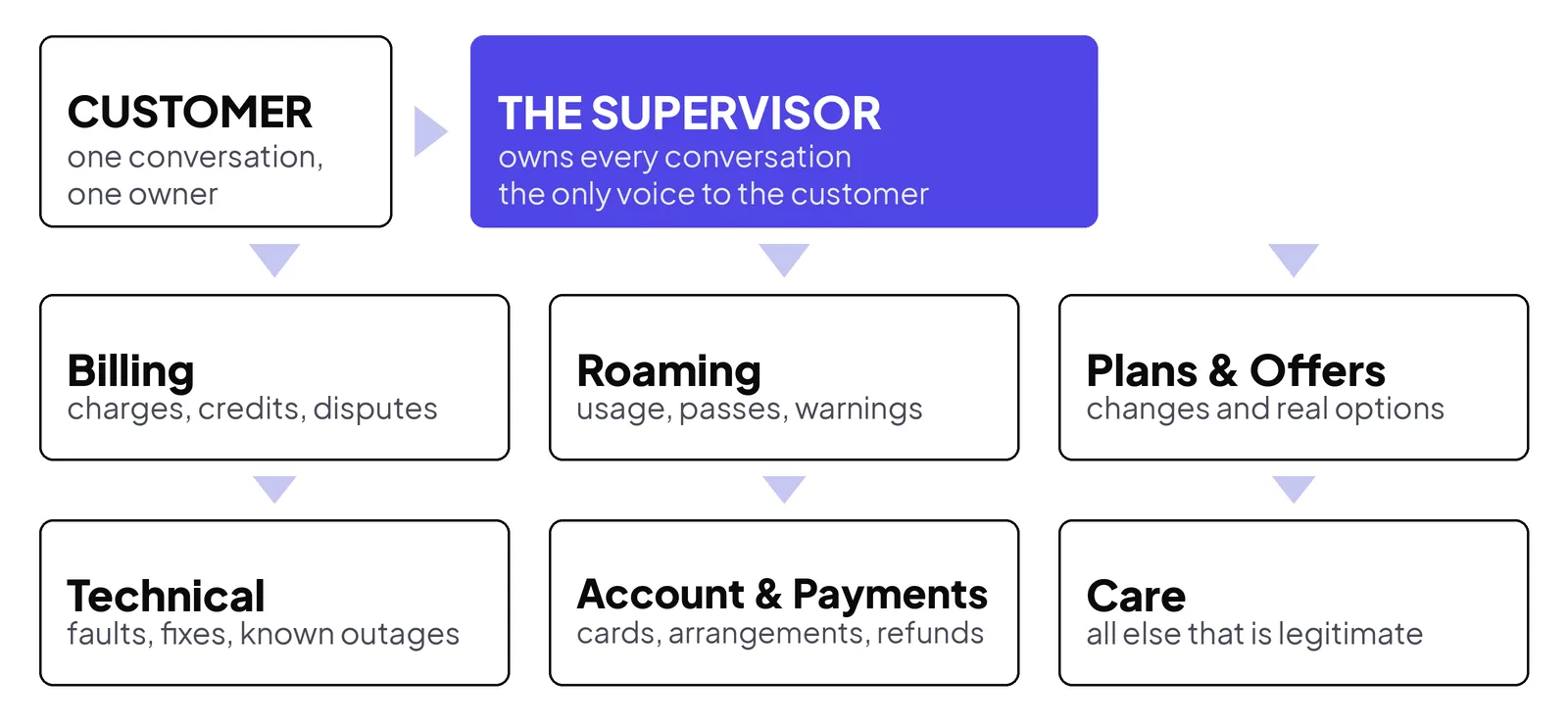
A single supervisor owns every conversation from first message to last. Under it sit specialist desks: billing, roaming, plan changes and offers, technical support, account and payments, and a care desk for everything legitimate that falls outside the other five.
The desks never talk to the customer. Each works its part of the problem and hands back findings: what it checked, what it found, what it proposes. Only the supervisor speaks, in one voice, and only the supervisor can put a proposal in front of the customer. That is the choice everything else hangs on: every guarantee the company cares about (figures quoted verbatim, a confirmation actually asked for, policy cited for a policy claim) is enforced in one place instead of hoped for in six.
The desks are deep where a support operation is deep. A troubleshooting walk interrupted by a billing question resumes at the exact step it stopped. If operations already knows about a fault in the customer's area, the agent says so up front, in the operations team's own words, instead of marching the customer through device checks for a problem that was never theirs.
Identity before anything consequential
Explaining a bill is one level of trust. Changing a plan, replacing a payment card, refunding money is another, and the blueprint refuses to blur them.
Before anything consequential can happen, the customer proves who they are: account details first, then a one-time code. Three wrong codes end it. Verification locks, the conversation goes to a person, and no persuasion inside the chat reopens it. An action re-checks everything at the moment it runs: identity still verified, confirmation actually given for this action, policy limits still met by the figures as they now stand. A plan change quoted against Tuesday's balance is not executed against Thursday's; if the account has moved, the proposal is marked stale and re-quoted from live figures, for a fresh yes.
Struggling through verification is itself a signal, so after repeated failed attempts the agent offers a person early. And a returning customer, once verified, is greeted from the record: the complaint still open and the date its response is due, the dispute in flight, the callback booked.
A dispute is decided on the bill
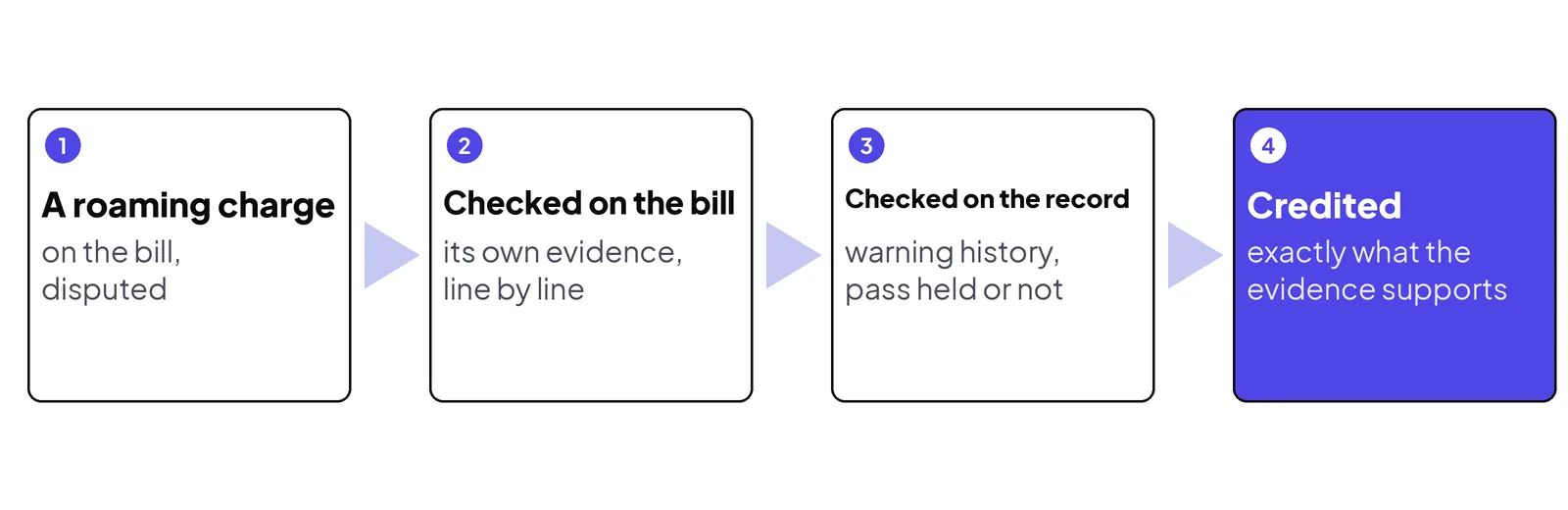
Billing disputes are where support agents quietly bleed money, usually by being agreeable. This blueprint takes the opposite position: a dispute is decided on the evidence carried in the bill itself.
Each disputed line is examined on its own facts. A charge that duplicates another, a charge levied after the account was cancelled, a charge billed above its proper rate: those are evidenced, and they credit, the duplicate in full, the wrong rate for exactly the excess. A line the record clears is declined, with the reason in plain words the customer can argue with. Roaming charges are decided from the account's own history: usage past the fair-use ceiling with no warning ever sent credits; usage inside a pass the customer bought, or after a recorded warning, stands.
All of it runs under written caps. Credits within the cap settle at the desk. A dispute above the cap is neither refused nor forced through; the case escalates to a person with its evidence and reasoning intact. Goodwill runs on a separate, smaller allowance, and the desk reads the account's recent credit history before offering any, so generosity has a memory and a limit. Figures throughout are computed from the record; the model drafts the explanation and never invents a number.
Promises are kept in a ledger
Every support operation makes promises. A response to your complaint by Friday. A technician will call. The instalment lands on the first. Most operations keep those promises in the heads of whoever made them, which is to say they don't keep them.
Here, commitments are written down as they are made and tracked in one ledger: complaint response deadlines, booked callbacks, payment arrangement instalments. Each reads as kept, still pending, or broken, derived from the underlying record and the date, so the ledger cannot drift away from the books it summarises. A broken promise is not buried: it surfaces in the customer's next conversation, and it is listed in full in the daily quality review the operations team reads each morning.
Nothing apologises automatically or pays compensation on its own. A person sees the broken promise and decides what it is worth. The ledger's job is narrower and more valuable: the company can be held to what it said, because what it said is on the record.
Escalation is a rule, not a mood
Ask a support leader when a bot should hand over to a person and you usually get a feeling. This blueprint writes the feeling down as rules, and the rules fire the same way on every channel and at every hour.
Some things transfer immediately: threats, fraud reports, legal matters, a customer whose circumstances mark them as vulnerable. Asking for a human earns one genuine attempt to solve the problem; a second ask transfers at once, with no third pitch. Three turns with no progress transfer. Frustration that keeps rising while nothing lands triggers an early offer of a person before the customer has to demand one. The customer who wants to leave gets the same honesty: one save offer at most, built from real options the account qualifies for, and none if they say they want none.
When a transfer happens, the human does not start from zero. The handoff carries the issue in the customer's own words, what was tried, the figures the case turns on, and what the company still owes them. The packet is checked for completeness and its gaps named on the record, but a transfer is never delayed because the paperwork is imperfect. The customer needs a person; the gap is the team's information, not the customer's wait.
Honest limits
The playbook is finite, and the design would rather admit it than improvise. The desks are deep on the work the operation has defined (bills, faults, plans, roaming, payments, care), and a need outside that definition is logged as unhandled, counted, and shown to the team as a pattern worth designing for, never papered over with a plausible answer. Policy answers cite the policy they rest on; where no policy covers the question, the agent says so.
A few boundaries are deliberate. As shipped, the verification flow demonstrates the steps end to end; a live deployment sends a real one-time code to the customer's phone or email and keeps only proof it matched. Reading free-form customer language well is the connected model's contribution; the built-in fallback assembles replies from findings, and is honest about being a fallback.
Work with us
If your support operation runs on an agent that sounds helpful while credits leak, promises evaporate, and escalations depend on the customer's patience, the fix is structural: one accountable owner, evidence before money, rules before feelings. Start with Trida AI's intake: tell us where your conversations break down.
Get the Code on GitHub: github.com/tridaai/blueprint-cx-resolution