
Batch Jobs Are Not Slow Chat
Plenty of production work has nobody waiting for it. The overnight classification run. The eval set replayed after a prompt change. Ten thousand documents that need extracting before Monday, not before lunch. Teams often run that work through the same synchronous endpoint as their live product, one request at a time, and pay full price for an answer they will not read for hours.
The batch APIs exist for exactly this work, and the discount is the least interesting thing about them. OpenAI's Batch API charges 50% less than its synchronous endpoints, Anthropic's Message Batches API charges 50 percent of standard prices, and Google's batch inference for Gemini on Vertex AI is also priced at a 50% discount to real-time inference. Three competitors landing on the same number tells you what the trade is. You give the provider your work as a job and let it choose when the work runs. In return the price halves.
What changes is not the model. It is the contract around the call, and teams that treat a batch as a slower chat request discover the differences in the wrong order.
A job, not a conversation
A synchronous call is a conversation with a deadline measured in seconds. You send a request, you hold a connection, you get one answer or one error, and the code that asked is still standing there to deal with it.
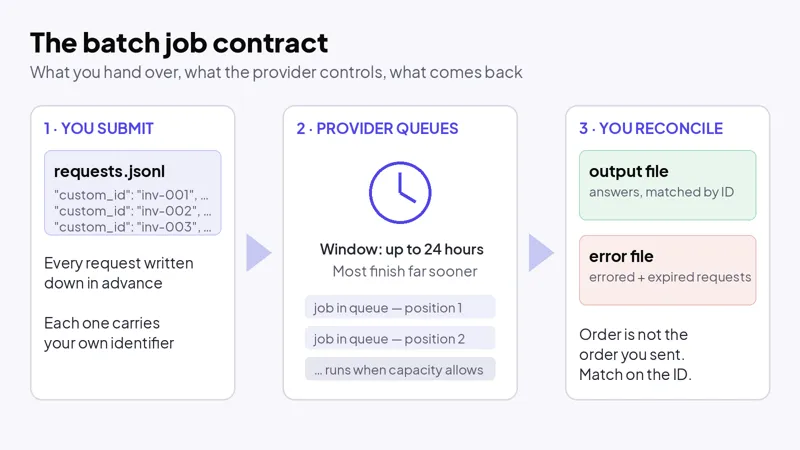
A batch removes the person holding the connection. You assemble every request up front, each with your own identifier, and submit the set as one file or one request list. OpenAI takes a JSONL file of up to 50,000 requests; Anthropic takes up to 100,000 requests or 256 MB, whichever comes first. The provider runs them when capacity allows. OpenAI's completion window is 24 hours, often much faster in practice; Anthropic says most batches finish in under an hour, and any request still unprocessed after 24 hours expires.
That shape rules some work out immediately. A batch request can't depend on the answer to the previous one. There is no turn two informed by turn one, no tool result fed back mid-job, no person approving a step before the next step runs. Anthropic doesn't accept streaming inside a batch, because the result is a file, not a stream. If your workflow needs a loop, the loop has to live outside the batch: one batch per stage, with your own code reading the stage's output before assembling the next stage's input.
The results file is the interface
Here is the part that catches people. Results do not come back in the order you sent them. Both OpenAI and Anthropic say so plainly, and both give the same instruction: match every result to its request by the identifier you assigned, never by position.
That sounds like a footnote. It is the design. A batch job needs a reconciliation step that a synchronous call never does, because a synchronous caller knows which request its answer belongs to. Your batch code has to join the output file back to the input list, count what came back, and account for everything that did not.
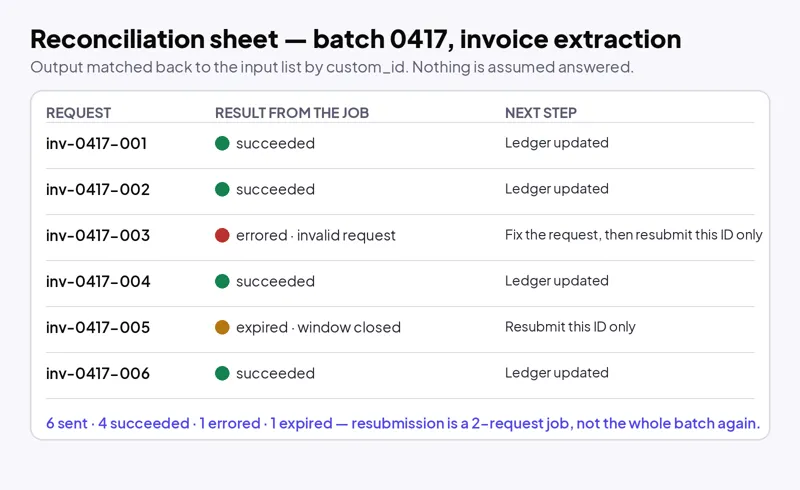
And some of it will not come back clean. A finished batch can hand you two kinds of remainder. Requests that errored, with the error recorded per request rather than raised in your process. Requests that expired because the window closed before they ran — OpenAI writes those to the error file as expired, and completed requests are still returned and still charged. Then there is the count itself, which is your job rather than the provider's: reconcile the identifiers that went in against the ones that came back, because a file that parses isn't proof that every line in it was answered.
So the deliverable of a batch integration is not the submission call. It is the ledger you keep around it: which identifiers went in, which came back succeeded, which errored and why, which expired, and which of those get resubmitted. Resubmission is where batches bite teams that skipped the ledger. Send the whole job again because ninety lines failed and you have now paid twice for the nine thousand that succeeded, and in a workflow with side effects you may have applied them twice too. Resubmit by identifier, from the ledger, and the retry is a small job. Resubmit from memory and it is a second incident.
What the discount actually buys
The separate capacity is worth naming, because it is easy to overlook next to the price. OpenAI states that batch jobs do not count toward the standard per-model request and token rate limits, and Anthropic likewise keeps batch usage under its own limits rather than the Messages API's. A large overnight job therefore does not compete with your live traffic for the same headroom. For teams whose bulk work currently runs at 2 a.m. precisely to avoid starving the product, that separation can matter as much as the halved bill.
There is also a deadline honesty to it. A synchronous integration pretends every request matters now, and then queues, retries and times out its way to finishing sometime tonight anyway. A batch states the deadline up front — inside a day, and under an hour for most Anthropic batches — and prices the work accordingly. If the honest deadline for a job is tomorrow morning, saying so in the API you call isn't a compromise. It's the accurate description of the work.
Where batching stops
Batch is the wrong tool the moment a person is waiting. Support answers, search, anything inside an interactive session: a job that finishes sometime in the next day is not a slow version of those products, it is a broken one.
It is also wrong for work you cannot enumerate in advance. If the request list depends on what a person does next, or on live state that will change while the job sits in the queue, the input file is stale before it runs. And expiry is a real outcome, not a theoretical one: a job that expires returns partial results, so a workflow that cannot tolerate a partial set needs its own completion check before anything downstream consumes the output.
One more limit is quieter. Results aren't kept forever. Anthropic makes batch results downloadable for 29 days after creation; OpenAI's output and error files expire 30 days after creation by default. The provider's file is a delivery mechanism, not your archive. Download it, reconcile it, and store your own copy, or the record of what the job produced disappears on a schedule you did not set.
Our rule is simple to state and worth applying before the invoice argument starts. If the work is independent, enumerable now, and honestly due in hours, submit it as a job and build the ledger. If any one of those three fails, keep it synchronous and pay for the conversation. The discount follows from the shape of the work. It was never the reason.
Work with us
If your overnight and bulk model work is still running as thousands of one-at-a-time calls through your live endpoint, we can help you separate the jobs from the conversations and build the reconciliation around them. Tell us about the workload through Trida AI's intake and we will start with which of it can honestly wait.